- Pontefract Castle 13th Century
- 1240 - On 22nd July 1240, John de Lacy, lord of Pontefract Castle, died. He was one of the 25 barons who forced the royal sealing and overseeing of the enactment of Magna Carta in 1215.
- 1298 - On 22 July 1298, Sir Henry de Lacy, lord of Pontefract, in the First War of Scottish Independence, led the first line of English cavalry at the Battle of Falkirk against the Scots under William Wallace. Scottish casualties were heavy and although Wallace evaded capture, he soon resigned as Guardian of Scotland. Reputedly, Edward I’s huge army for this campaign was in the order of 26,000 men and 3,000 cavalry.
- Pontefract Castle 14th Century
- 1395 - On 22nd July 1395, delegates from the Duchy of Aquitaine met Richard II at Eltham Palace to tell the king that Aquitaine was irrevocably annexed to the Crown of England and could not be given away by him. Evidence produced included a letter by Edward III publicly affirming the duchy’s established status and assurances by Richard himself during earlier negotiations that Aquitaine’s privileges were ‘sacrosanct’. A plan had been mooted to grant Aquitaine to John of Gaunt, lord of Pontefract, so that Richard could avoid doing homage to the King of France for this territory.
- Pontefract Castle 15th Century
- 1476 - On 22nd July 1476, the Fotheringhay Procession left Pontefract with the bodies of Richard Duke of York (former lord of Sandal Castle) and his son Edmund Earl of Rutland, who had both been killed at the Battle of Wakefield in December 1460. These bodies had been interred in the Franciscan Friary of St Richard, which was located on the site of the present day Valley Gardens. Led by Richard, Duke of Gloucester, the procession passed through Doncaster, Blyth, Newark, Grantham and Stamford reaching Fotheringhay on the 29th July.
- Pontefract Castle 16th Century
- 1537 - On 22nd July 1537, Lord Darcy, Constable of Pontefract Castle during the previous year’s Pilgrimage of Grace, who had been beheaded for treason three weeks before, was posthumously degraded from his rank as Knight of the Garter and his vacant stall bestowed upon Thomas Cromwell, who had drawn up the charges against him and had then been one of his judges.
- Pontefract Castle 17th Century
- 1679 - On 22nd July 1679, after the passing of the Act of Uniformity (1662) against popish recusants intent on re-establishing Roman Catholicism and conspiring against the life of Charles II, an affidavit was presented to the Sessions at Pontefract: ‘As for Mr Thomas Hippon and Alis Hippon, they become bound before Mr Whyte to appear at this Session, as popish recusants. As for Mr John Hippon, Margaret Thimbleby and Alis the wife of John Spinke, they are non est Inuentus’ i.e. not yet found in this jurisdiction.
- Pontefract Castle 20th Century
- 1966 - On 22nd July 1966, Ferrybridge Henge and two round barrows were first listed and protected as a Scheduled Ancient Monument: List Entry Number: 1005789. A Neolithic henge near Ferrybridge, West Yorkshire (grid reference SE47462424), it is close to the A1 and M62 and Ferrybridge power station. Ferrybridge Henge is the furthest south of Yorkshire's henges, and is the only one in West Yorkshire. There was activity on the site before the current henge in the form of circular monuments and hengiform monuments dating from 3500 BC to 3000 BC. Ferrybridge Henge dates from around 3000 BC to 2500 BC. Around 2000 BC–1500 BC, during the early Bronze Age, barrow burials were performed on the site. Inhumations were discovered with grave goods such as ceramic pots and flint tools. The area was probably abandoned from about 1500 BC to 500 BC when there was some reoccupation by Iron Age farmers. The henge was not cultivated and may have been retained as a shrine for the Iron Age people of the area and later during the Romano-British period. An Iron Age sword scabbard was discovered in the inner henge ditch as well as a Roman coin. That burials continued in the area around the henge in the Saxon period despite the presence of a Christian cemetery nearby has been taken as evidence of pagan beliefs prevailing in the area. Ferrybridge Henge and its surrounding area were used as farmland during the medieval period.
The site was excavated by West Yorkshire Archaeological Services in 1991. In 2007, a suspected extension of the henge was unearthed near Pontefract. It was discovered when archaeologists were investigating a site intended for the construction of a row of houses; once the archaeological survey was complete, the construction went ahead. Ferrybridge Henge is a circular site and is about 180 metres (590 ft) in diameter. The henge is surrounded by two ditches and a bank. The inner ditch is 10 metres (33 ft) wide and 2.5 metres (8.2 ft) deep. There is a 15-metre (49 ft) wide berm between the inner ditch and a 15-metre (49 ft) wide limestone bank. Separating the bank from the outer ditch is another berm, also 15 metres (49 ft) wide; the outer ditch is 12 metres (39 ft) wide and 1.5 metres (4.9 ft) deep. This layout is typical of other henges. The site has two entrances, one in the north east and one in the south west.
- Pontefract Castle 21st Century
- 2016 -
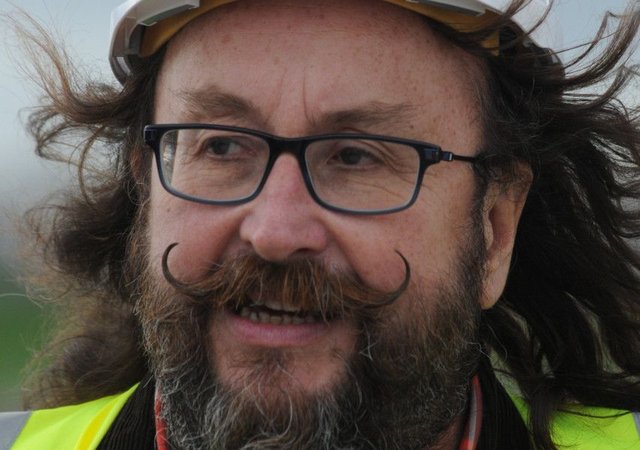
 On 22nd July 2016, the television programme, 'The Hairy Builder with Dave Myers' was broadcast on BBC2. The programme showed Dave Myers (one of the two famous 'Hairy Biker' cooks ) helping builders restore parts of Pontefract Castle for future generations.
 - Sandal Castle 13th Century
- 1298 - On 22nd July 1298, John de Warenne , 6th Earl of Surrey and owner of Sandal Castle, was present at the Battle of Falkirk which would prove a decisive English victory in Edward I's conflict with the Scots.
- Sandal Castle 17th Century
- 1645 - On 22nd July 1645, Parliament's Colonel General Poyntz called on the Royalist defenders to surrender Sandal Castle, but they rejected the call, although hopes of immediate relief were remote.