- Pontefract Castle 14th Century
- 1327 - On 21st September 1327, Edward II was ‘murdered’ at Berkeley Castle on the orders of his wife Isabella and her lover Roger Mortimer. With the king's death, Isabella’s new estates were worth 20000 marks (£18.3 million in today's money), an income greater than even Thomas of Lancaster at the height of his powers. Indeed one of the estates Isabella now controlled was Pontefract castle.
- 1368 - On 21st September 1368, Thomas Swynford, son of Sir Hugh Swynford and Katherine (later Duchess of Lancaster) was born. Some have questioned whether he was an illegitimate child of John of Gaunt, receiving 100 marks (over £77,000 in today's money) in his will. In 1390, Thomas served with Henry of Derby (later Henry IV) in Calais and later Prussia. In addition to being Constable of Pontefract Castle, in 1402 he was Sheriff of Lincoln, Captain of Calais by 1404 and was later involved in negotiating a treaty with France and Flanders.
- 1371 -
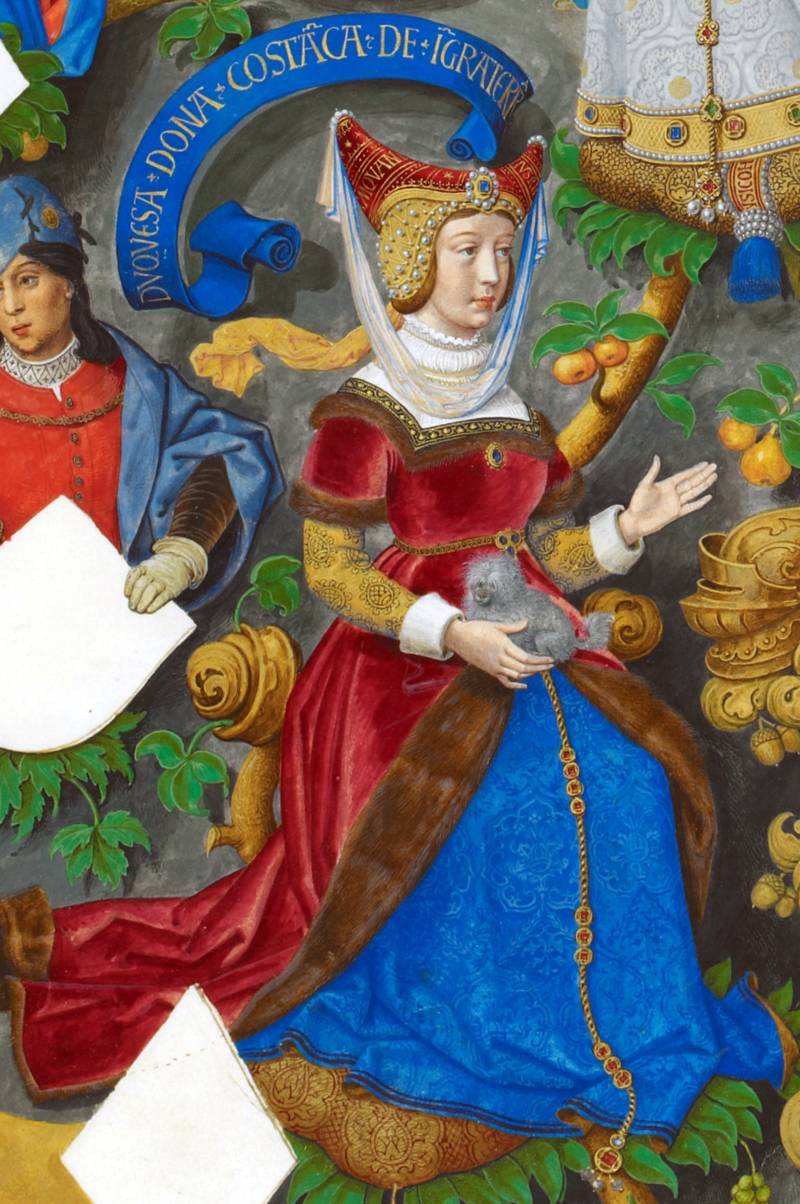
 On 21st September 1371, John of Gaunt, lord of Pontefract, married Constance of Castile. It was his second marriage, whereas his first marriage had been for love, this marriage was for ambition. By this marriage, he became King of Castile and Leon, and he was addressed by that title from that point on. After this, the lords of Pontefract grew in strategic, military and political importance in the country.
 - 1397 - On 21st September 1397, John of Gaunt, lord of Pontefract, in his role as Steward of England, presided over the trial of Richard Fitzalan, 4th Earl of Arundel, regarding his part in an armed, traitorous insurrection against the king by the Lords Appellant ten years earlier. Gaunt condemned Arundel ‘to be drawn, hanged, beheaded and quartered, and the lands descending from your person, both entailed and unentailed, to be forfeited forever by you and your heirs.’ Richard II commuted the sentence to beheading only. The Earl of Warwick, Thomas de Beauchamp, a co-conspirator, was banished to the Isle of Man and Gaunt’s brother, Thomas of Woodstock, the Duke of Gloucester, was posthumously tried and declared a traitor. Sir Thomas Mortimer, another Lords Appellants’ rebel, died in exile in 1399.
- Pontefract Castle 15th Century
- 1474 - On 21st September 1474, Richard, Duke of Gloucester (later Richard III), opened a commission of oyer and terminer (judges of assize inquiring into all treasons, felonies and misdemeanours in specified counties) at Pontefract Castle. The commission, lasting until the 25th of the month, was intended to resolve peacefully a bitter dispute between two of the North’s most powerful lords, Sir John Savile and Sir John Pilkington but, unfortunately, clashes continued until Pilkington’s death in 1479. Richard’s unsuccessful intervention in this case was, nevertheless, indicative of his overall ‘calming’ influence during his tenure as ‘Lord of the North’ which improved the prospects of peace and prosperity in the region.
- 1478 - Between 21st and 25th September 1478 at Pontefract Castle, Richard, Duke of Gloucester, presided, with Edward IV, over a commission of oyer and terminer (an inquiry into treasons, felonies and misdemeanours committed in specific counties).
- 1483 - On 21st September 1483, Richard III and Queen Anne left York having witnessed their son’s investiture as Prince of Wales and Earl of Chester, to travel to Pontefract, staying there until early October. It is likely that news of potential uprisings in the south reached Richard at this time.
- Sandal Castle 15th Century
- 1411 - On 21st September 1411, Richard Duke of York was born at Conisbrough to Richard 3rd Earl of Cambridge and Anne Mortimer. Richard would become one of the most pivotal figures of the first half of the fifteenth century: challenger, Protector and ultimately claimant to the English throne. Richard’s northern base would be at Sandal Castle and Richard would die on the 30th December 1460 at the Battle of Wakefield, in sight of his castle.