This Coming Week In History
This week in history
| Date | Event |
|---|---|
| 1/7/1230 | On Ist July 1230, John de Lacy, lord of Pontefract, left Nantes and accompanied Henry III on his way to Poitou. Henry’s original intentions of conquest morphed into a promenade through the country as many towns were ostensibly loyal to Louis IX of France and Henry could not rely on the loyalty of the Poitevin barons. |
| 1/7/1300 | On 1st July 1300, Sir Henry de Lacy, lord of Pontefract, was made Commander of the 1st Division of the King’s Army by Edward I on his Scottish campaign. This position had been similarly conferred on Henry in June 1298. |
| 1/7/1345 | On 1st July 1345, Henry, 3rd Earl of Lancaster, brother of the executed’ traitor’ Thomas, Earl of Lancaster and lord of Pontefract, was appointed a member of the advisory council to aid the Keeper of the Realm whilst Edward III went abroad. At this time, he was also appointed as an adviser to Edward III’s six-years-old son Lionel of Antwerp, his grandson-in-law and great-great-nephew. |
| 1/7/1370 | On 1st July 1370, the Black Prince in discussions with John of Gaunt, lord of Pontefract, and Edward III rejected a policy of punishment towards French towns that had gone over to Charles V of France and now wanted to return to English allegiance. This decision also gave his brother, Gaunt, overall authority in the conduct of military operations but any decision on the fate of Limoges’ citizens would have to be agreed by both men. |
| 1/7/1495 | In July 1495, Henry VII commissioned a Nottingham tradesman, Walter Hylton, to erect an unpretentious alabaster tomb for Richard III (lord of Sandal) over the ex-king’s grave near the altar in Leicester Grey Friars. Payment of £50 (£48,000 today) was paid in two instalments with a separate fee of £10 (£9600 today) issued to James Keyley two months later for additional work on the tomb. This edifice remained in situ until about 1538 when the friary was suppressed. Despite Richard’s reputation suffering Tudor ridicule (and more), Henry saw an opportunity to lessen any animosity towards him for Richard’s quick, ‘unseemly’ burial and remind any Yorkist supporters that transferring their loyalties to Perkin Warbeck would ignore Richard’s own delegitimization of Edward IV’s sons. |
| 1/7/1645 | On 1st July 1645, the besieged Royalist garrison saw the Parliamentarians carrying faggots and scaling ladders down to the church which raised their suspicion of an intended assault. The guards were then doubled and at about 12 o'clock most of the troops were under arms, ready to receive any attack made by the Parliamentary forces. However the opposition remained in their works during the night. The number and strength of the besiegers rendered any sally by the garrison more dangerous to themselves than to the Parliamentary forces and from this period the besieged made no sallies against the enemy's works. On the other hand, Parliament's Colonel General Poyntz did not wish to expose his men to danger and so each party watched the other rather than carry on any vigorous enterprises. |
| 1/7/1879 | On 1st July 1879, public passenger train services began at Baghill railway station (on the Sheffield to York line) greatly increasing access to Pontefract town and castle for Victorian visitors. The castle, by this time, was often viewed as a romantic ruin and pleasure garden with tennis courts and ornamental rose gardens. Tanshelf railway station near the centre of the town had opened eight years earlier giving easy access to Pontefract Racecourse. This station had closed in 1967 but was opened on 11th May 1992 when the line between Wakefield Kirkgate and Pontefract Monkhill was re-opened. Pontefract’s other railway station, Monkhill was opened by the Wakefield, Pontefract and Goole Railway in April 1848. |
| 1/7/1893 | On 1st July 1893, ‘The Spectator’ magazine reported: ‘Lord Randolph Churchill, speaking at Pontefract on Saturday last, made a very happy point by saying that Mr. Gladstone’s new financial resolutions would condemn Ireland to penal,—he meant, he said, “ financial,”—servitude for six years. This is, indeed, precisely what the Parnellites think of the step taken. They have issued an address to their Irish friends in the United States, imploring their support to resist and defeat this withdrawal of all financial power from the Irish Legislature for this long period, which they regard as fatal to any genuine kind of Home-rule………. The Pontefract by-election ended in the return of the Gladstonian by the narrow majority of 32, Mr. T. W. Nussey receiving 1,191 votes, against 1,159 given for Mr. Elliott Lees, the Conservative.’ |
| 2/7/1440 | On 2nd July 1440, on the day Henry VI sealed the terms of Charles, Duke of Orleans’ release from Imprisonment, he appointed a new Lieutenant-General and Governor of France, Richard, Duke of York (lord of Sandal Castle) for the second time. York was promised an annual income of £20,000 (£20.3 million in today’s money) to support his position. |
| 2/7/1483 | In the first days of July 1483, Richard III’s (lord of Sandal) northern forces of around four thousand men under the command of the Earl of Northumberland and Richard Ratcliffe arrived In London with Richard greeting them bareheaded as a sign of respect. Richard was preparing to avoid/avert any troubles surrounding his coronation days later. |
| 2/7/1637 | On 2nd July 1637, Sir John Jackson, MP, died. Knighted on 19 April 1619, in 1624, Jackson was elected Member of Parliament for Pontefract in the Happy Parliament. He was re-elected MP for Pontefract in 1625, 1626 and 1628 and sat until 1629 when King Charles decided to rule without parliament for eleven years. |
| 2/7/1644 |  On 2nd July 1644, Cromwell was victorious at the Battle of Marston Moor at Tockwith, near York. Some of the Royalist survivors escaped the battlefield and took refuge at Pontefract Castle, where they joined the garrison under the command of Sir Richard Lowther. On 2nd July 1644, Cromwell was victorious at the Battle of Marston Moor at Tockwith, near York. Some of the Royalist survivors escaped the battlefield and took refuge at Pontefract Castle, where they joined the garrison under the command of Sir Richard Lowther. |
| 2/7/1645 | On 2nd July 1645, Nathan Drake, Royalist diarist, recorded: ‘ in the Afternoone our dutchman playd his Cannon from the Platforme by Treasurers Tower into the Markitt place, where we saw 2 or 3 kild dead..’ The unnamed ‘dutchman’ is first mentioned in the diaries on 10th June this year, most probably associated with his countrymen’s draining operations in the east of Yorkshire under the patronage of King Charles I. |
| 26/6/1322 | On 26th June 1322, Alice de Lacy, suo jure Countess of Lincoln and suo jure Countess of Salisbury, surrendered a large part of her estates to the Crown after the execution of her husband, Thomas, Earl of Lancaster, on 22nd March that year. Alice had been imprisoned at York with her stepmother, Joan Martin, soon after the death of Thomas. Many of Alice’s estates were given by Edward II to his court favourites, Hugh Despenser and his son, Hugh Despenser the Younger. Edward II had made the following declaration from York, on that day, regarding the above: ‘Enrolment of grant by the said Alesia (late the wife of Thomas, Earl of Lancaster, daughter and heiress of Henry de Lascy (sic), late Earl of Lincoln) to the king that all the manors, towns, etc., knights' fees, advowsons, etc., pertaining to the castle, town, and honour of Pontefract, and all other castles, manors, etc., in the county of York, that Joan, late the wife of Henry de Lacy, earl of Lincoln, Alesia's father, and others hold in dower or otherwise for life or for terms of years, which ought to revert to Alesia, shall revert to the king after the death of Joan and the others.’ |
| 26/6/1404 | On 26th June 1404, Henry of Monmouth, Prince of Wales (later Henry V), wrote to his father from his Worcester headquarters thanking him for his kind letter written from Pontefract five days earlier. The king had requested his son to go to the help of the Sheriff of Hereford who was suffering ‘greatly from the ravages of the Welsh rebels.’ |
| 26/6/1483 | On 26th June 1483, after being petitioned at Baynard's Castle by a delegation from the City of London to take the throne, Richard Duke of Gloucester deposed Edward V and reigned as Richard III. Richard’s right to reign was confirmed by the Act Titulus Regius which denounced any further claims through his brother’s, Edward IV , heirs. The Titulus Regius was issued in 1484 and repealed the following year by Henry VII. |
| 26/6/1484 | On 26th June 1484, a ten-months’ truce with Brittany was instigated by Richard III, lord of Sandal, sending 1000 archers to help it against France. A secret plan was formulated to seize and deport Henry Tudor by treasurer Landois whilst Duke Francis was mentally incapacitated but Tudor was forewarned and escaped from Vannes to the French border. |
| 26/6/1645 | The besieged Royalist garrison suffered the loss of Sir Jarvis Cutler, who died from a fever. The Parliamentarians would not let fresh provisions to be brought to him from the town and his wife was allowed to visit him only once, bringing a chicken and a joint of meat. When dead, he was not allowed by the enemy to be buried in the church or among his ancestors. On 26th June 1645, he was buried in the chapel in the castle and after the funeral his wife was not permitted to leave the castle. The besieged began to suffer severely from lack of fresh provisions and desertions became frequent. In the night of 26th June, a man, named Metcalf, deserted and informed General Poyntz that the surgeon who attended the wounded in the castle communicated information to the garrison and supplied them with tobacco and other articles, in consequence of which the man was imprisoned. |
| 26/6/1979 | On the 26th June 1979, the Bond film ‘Moonraker’ starring Roger Moore, premiered at the Odeon Cinema, Leicester Square. The character Jaws was seen biting through a thick electric cable actually made of liquorice produced in Pontefract and sent on to Pinewood Studios. Liquorice had been grown at the castle in the 1700s and more than ten factories making liquorice ‘delights’ were in the area. |
| 27/6/1461 | On 27th June 1461, an eight-years-old Richard, brother of Edward IV and later to be Duke of Gloucester, King Richard III and steward of the Duchy of Lancaster north of Trent with official residence at Pontefract Castle, was amongst twenty-eight Knights of the Bath created by Edward in preparation for his coronation the following day. |
| 27/6/1483 | On 27th June 1483, Piers Curteys, the Keeper of the Great Wardrobe, signed indentures for work to be completed by 3rd July for the coronation of Richard III, lord of Sandal. Amongst the honoured guests listed with sumptuous clothes to be supplied, was the recently deposed Edward V now styled ‘lord Edward, son of late King Edward the Fourth.’ Unsurprisingly, Edward did not attend the coronation nine days later. |
| 27/6/1645 | On 27th June 1645, the besieging Parliamentary forces of Pontefract Castle had a Day of Thanksgiving for the late success and victory over the king at the Battle of Naseby. They then fired volleys and played their cannon on the besieged Royalists. |
| 28/6/1645 | At the end of June 1645, Sandal Castle was besieged by a force of 300 dragoons under Colonel Morgan. These were mounted infantry with matchlock muskets. However, with insufficient fodder for their horses, they could not continue the siege and withdrew to Pontefract. |
| 28/6/1645 | On 28th June 1645, news was received by the castle garrison of a Royalist success at Newark. On this day, permission was given to Lady Cutler to leave the castle, after being trapped there attending the funeral of her husband, Sir Jarvis Cutler. However, the besieging Parliamentary forces seized her and along with her maid, chaplain, and accompanying tenant they were searched to see if they were carrying any letters. She was kept till the following day when she returned to the castle. Here she was refused admission and remained in the street until 10 o'clock with her maid and chaplain. They were then permitted to go into the town where they remained until the next day and then departed. |
| 28/6/1892 | On 28th June 1892, ‘The Journal of Gas Lighting, Water Supply and Sanitary Improvement’ recorded: ‘Completion of the New Water Scheme for Pontefract.—The Roall water scheme to supply Pontefract and the district with an improved supply of water was completed yesterday week. The first sod of this undertaking was turned on July 25, 1889, by the then Mayor (Mr. W. Mathers) ; and the work has been satisfactorily carried out under the supervision of Mr. G. Hodson, the Engineer, by Messrs. Vickers and Son, of Nottingham. The mains from the pumping-station at Roall are laid for a distance of nine miles to the storage reservoir on the Park Hill at Pontefract. The cost of the works will amount to close upon £28,000 (£3.64 million in today’s money). Since the completion of the work, the contractors have been encountering serious difficulties. Last Thursday morning, when pumping operations commenced, owing to an accumulation of air in the mains, the pipe burst in Teront Street, Tanshelf, and a large volume of water poured forth, and caused a suspension of traffic. The power required to force the water into the reservoir on the Park Hill is immense, and it is feared other difficulties may arise before the works are a thorough success.’ |
| 28/6/1940 | On 28th June 1940, it was reported that a one-hundred-years-old cannon that had stood at Sandal castle for nearly thirty years was to be presented to Wakefield Corporation as part of the war’s scrap metal collection scheme. The cannon had been given to Mr Edwin Lodge Hirst when he was Mayor in 1912. |
| 29/6/1237 | On 29th June 1237, John de Lacy, Baron of Pontefract, was appointed by Henry III as one of several lords overseeing the arrival and mission of Cardinal Otto of Tonengo, Pope Gregory IX’s legate. Otto had been requested by the king in order to provide guidance and help in overcoming his precarious financial situation and faltering peace treaty with Scotland. His barons were resentful and mistrusting of foreign interference in matters of state with Matthew Paris recording: “Our king perverts all things. In every way he sets at nought our laws and disregards his plighted faith and promises……… now he has secretly called a legate into the country, who will change the whole face of the land: now he gives and now at will he takes back what he has given.” Otto was to remain in England until the 7th January 1241. |
| 29/6/1347 |  On 29th June 1347, John de Warenne, the 7th and final Earl of Surrey (some historians show him as the 8th Earl), died at Conisbrough Castle and was buried in Lewes Priory, East Sussex. The earl's land, including Sandal Castle, reverted to the crown. John had lost his possessions during his dispute of 1317 with Thomas, Earl of Lancaster, and, on the subsequent execution of Thomas in March 1322, the lands became the Crown's ownership. It was not until 1326 that John regained some of his lands, and only in 1334 that he regained the castles at Conisbrough and Sandal, but only on the proviso that they remained with him until his death, when they would again revert to the Crown. On the death of John, Sandal passed to Edward III, who granted it to his fourth son, Edmund Langley, Duke of York. It would be from this lineage that the castle would come into the possession of Richard Plantagenet, Duke of York, and become his key base in the North during the Wars of the Roses, 1455-1485.
 |
| 29/6/1645 | On 29th June 1645, Nathan Drake, Royalist diarist, recorded: ‘..a little after no one, the Enemyes Genrall (Poyntes) Nathan Drake, Royalist diarist, recorded sent down the Lady Cuttler wth hur waytingmaid to the Barbican gates againe, she having not had any meate of 24 howers. Our Governor of the Castle would not suffer hur to Come into the Castle againe, because they had sent for hur out & given hur free liberty to goe home to hur Children, therefore he thought it sttod not wth his honor to be so Fooled by them, and by that meanes the poore Lady wth hur maid & hur Chaplin staid starving in the streetes till about 10 a Clock in the night, at wch time the Enemy sent for hur up into the Towne, & for any thing we heare, she sent for 2 horseyes that night, & so went away the next day. There was this night 2 Boan fires…made upon Sandoll Castle and we answered it wth one heare upon the Round Tower. We supposed to be good newes because of 2 Fires.’ |
| 30/6/1253 | At some time in 1253 (no sources give an exact date), John de Warenne, 6th Earl of Surrey and owner of Sandal Castle, was convicted of unjustly enclosing common land in Wakefield and was ordered to remove the fences he had just erected. John was known as a strict and unpopular landlord. |
| 30/6/1268 | At some stage in 1268 (some sources credit this to 1269 although there is no exact date for either), John de Warenne, 6th Earl of Surrey and owner of Sandal Castle, was involved in a land dispute with Henry de Lacy, Lord of Pontefract. This quarrel was in danger of escalating into a private war, with both sides raising armies, until King Henry III intervened and the royal justices determined that the pastureland in question belonged to Henry de Lacy. |
| 30/6/1286 | On 30th June 1286, John de Warenne, 7th Earl of Surrey, was born. He succeeded his grandfather, John de Warenne (his father having been killed in a tournament when he was only six months old), in September 1304 as Earl of Surrey, becoming a ward of Edward I. He was eight years old when his mother died. In 1306, he was married to King Edward I's granddaughter, Joan of Bar, when she was only ten. The marriage was unsuccessful and Joan was largely abandoned by her husband who had been trying to divorce her since 1313. John would have numerous illegitimate children during his life and would take ownership of Sandal Castle in 1304 at the age of eighteen. De Warenne’s aunt, Isabella de Warenne, was married to John Balliol, who became king of Scotland in 1292. |
| 30/6/1289 | At some stage in 1289 (the date is unclear), John de Warenne , 6th Earl of Surrey and owner of Sandal Castle, and Henry de Lacy Earl of Lincoln and owner of Pontefract Castle, formed part of a commission that was set up to hear complaints by the Scots of extortions committed by northern sheriffs. |
| 30/6/1404 | On 30th June 1404, Henry IV, from Pontefract, issued a passport for a quarter of a year to Sir John Sinclair, brother of Henry II Sinclair, Earl of Orkney. Henry had been captured following the Battle of Homildon Hill in 1402 and released on ransom. The battle had been a disastrous defeat for the Scots under Archibald Douglas, 4th Earl of Douglas, but a triumph for English forces led by Henry Percy, 1st Earl of Northumberland, and his son Harry ‘Hotspur’. It is surmised that Sinclair’s passport was a ‘safe passage’ granted by the king. |
| 30/6/1484 | On 30th June 1484, Richard III, lord of Sandal, and one-time Lord High Admiral of England, inspected the royal fleet at Scarborough to ensure its preparedness against incursions or invasion by the French or Scots and its ability to prevent the secreting of important persons, such as his nieces or ‘conspiring’ nobles, to the continent. |
| 30/6/1537 | On 30th June 1537, Lord Darcy, Constable of Pontefract Castle during the previous year’s Pilgrimage of Grace, was beheaded on Tower Hill and his head exposed on London Bridge. Contrary to his wishes that his whole body be buried by that of his second wife, Edith Sandys, Lady Neville, in the Friary at Greenwich, his headless body was buried at the Crossed Friars beside the Tower of London. |
| 30/6/1645 | On 30th June 1645, the besieging Parliamentary forces had a general rendezvous on Brotherton Marsh of all their horse in the area, which amounted to a thousand. They departed then in companies to different villages. The besiegers relieved their guard at New Hall with at least 600 men and different bodies of infantry moving in all directions. This led to the governor of the castle to conclude that the enemy seriously intended to assault the castle and he gave orders that the guard should be doubled and strict watch kept. |
| 30/6/1648 | On 30th June 1648, a report was made to the Commons that: ‘The enemy at Pontefract Castle still go on at pleasure, taking and plundering whom they please, and yet please to deal so with none but those who have been most active for the Parliament. Having quitted the Isle of Axholme, they came towards Lincoln, and yesterday entered the city, plundered the house of Capt. Pert, who is now in arms in Northumberland for the Parliament…..They have prisoners Capt. Bees, Capt. Fines, and others….They went further on, and took prisoner Mr Ellis; they brag they have 3000 listed in Lincolnshire…’ |
| 30/6/1888 | On 30th June 1888, the ‘Leeds Times’ reported that it had been decided to erect a boundary wall around Sandal Castle and also build a lodge. |
Last week in history
| Date | Event |
|---|---|
| 22/6/1307 | A papal letter by Pope Clement V, dated 22nd June 1307, authorised the Archbishop of York to give a commission to William de Pykeringe, archdeacon of Nottingham and canon of York, to reconcile the churchyard of Pontefract, which had been polluted by bloodshed. |
| 22/6/1449 | On the 22nd June 1449, Richard Duke of York, owner of Sandal castle, finally set sail from Beaumaris to take up his position as Lord Lieutenant of Ireland, almost two years after being appointed to the position. |
| 22/6/1483 | On 22nd June 1483, Dr Ralph Shaw (or Sha), a Cambridge doctor of divinity and brother of the Mayor of London, Edmund Shaw, delivered an ‘explosive’ sermon from the open-air pulpit at St Paul’s Cross in London. This was to vindicate Richard’s, Duke of Gloucester, lord of Sandal, claim to the crown. Shaw announced a ‘precontractual’ marriage/betrothal between Edward IV and Lady Eleanor Butler invalidating Edward’s later marriage to Elizabeth Woodville thereby rendering their children illegitimate and negating any rights to the throne. Shaw’s text from the fourth chapter of the Book of Wisdom quoted: ‘Bastard slips shall not take deep root.’ Bishop Stillington is later said to have confirmed this as he was present at Edward’s and Eleanor’s betrothal. Some sources even claim that Shaw questioned the legitimacy of Edward IV and his brother, George, Duke of Clarence, by reason of their mother’s Cecily Neville, Duchess of York, infidelity; citing Richard, Duke of Gloucester’s resemblance to his father, Richard, Duke of York, unlike his two brothers. |
| 22/6/1484 | Between 22nd and 23rd June 1484, Richard III stayed at Pontefract Castle after visiting York. During June of this year, Richard had been at Pontefract for twenty two days. |
| 22/6/1645 |  On 22nd June 1645, as soon as the day dawned, Parliamentary forces made a strong attack upon the guard in the Low Church, which they entered with a hundred men. Another party went up the trenches of the besieged Royalists and so to the castle. The guard in the church compelled those who entered to retreat, and those in the steeple gave the alarm to the Royalist garrison by ringing the bell. A continuous fire from the steeple and from the East Tower of the castle rendered the attempt of those who had entered the trenches useless, and so they retreated to their works, carrying their dead and wounded with them. After some time, the cannon planted at Monkhill, and carrying a ball of eighteen pounds in weight, began to aim against the lantern of the steeple. In about an hour and a half, they aimed thirteen times but did no damage. The besieged Royalists, in order to preserve the church and to protect their guard, played their cannon from King's Tower against the enemy's works at Monkhill and at the fifth discharge, dismounted the cannon of the Parliamentary forces. The remainder of the day was spent by the Parliamentarians remounting their cannon and throwing up works for its security. In the afternoon, the besieging Parliamentarians relieved all their guards, and in the evening, the besiegers conversed freely with the besieged and informed them of Cromwell's success and the almost final destruction of the forces belonging to His Majesty. The besieged Royalists considered this information as designed to induce them to surrender, and still hoped that they should soon be relieved. On 22nd June 1645, as soon as the day dawned, Parliamentary forces made a strong attack upon the guard in the Low Church, which they entered with a hundred men. Another party went up the trenches of the besieged Royalists and so to the castle. The guard in the church compelled those who entered to retreat, and those in the steeple gave the alarm to the Royalist garrison by ringing the bell. A continuous fire from the steeple and from the East Tower of the castle rendered the attempt of those who had entered the trenches useless, and so they retreated to their works, carrying their dead and wounded with them. After some time, the cannon planted at Monkhill, and carrying a ball of eighteen pounds in weight, began to aim against the lantern of the steeple. In about an hour and a half, they aimed thirteen times but did no damage. The besieged Royalists, in order to preserve the church and to protect their guard, played their cannon from King's Tower against the enemy's works at Monkhill and at the fifth discharge, dismounted the cannon of the Parliamentary forces. The remainder of the day was spent by the Parliamentarians remounting their cannon and throwing up works for its security. In the afternoon, the besieging Parliamentarians relieved all their guards, and in the evening, the besiegers conversed freely with the besieged and informed them of Cromwell's success and the almost final destruction of the forces belonging to His Majesty. The besieged Royalists considered this information as designed to induce them to surrender, and still hoped that they should soon be relieved. |
| 22/6/1897 |  On Tuesday, 22nd June 1897, celebrations for Queen Victoria's Diamond Jubilee commenced with ‘Dinner to the Aged Poor’. 275 people attended dinner in the Assembly Room. The dinner consisted of roast beef and plum pudding, with bread and cheese washed down with ale or aerated waters. At 2pm, school children and teachers of the town, numbering about 2000, marched from their schools to the Corn Market. Each child had received a medal at school before setting off. Groups taking part in the procession included: The Borough Band; The Pontefract Volunteers; The Fire Brigade; The St George Lodge of Oddfellows; The Pontefract Miners Association; The Old Tradesmen’s Association, and ‘The Cyclists of the Town and District in Cycling Costume, on plain or decorated machines. The procession finished at Pontefract Castle, where entertainments were provided for the children. At 5 o'clock, the children and teachers marched back to their schools where they were provided with tea, buns and sweet cake. At 10 o'clock that night, rockets were set off from Park Hill to signal the lighting of The Beacon Fire. Four local dignitaries each lit a corner of the Beacon, and the crowd sang ‘God Save the Queen’. Around the main streets of Pontefract, crowds walked to see the beacon and rockets, accompanied by outbursts of national music. The celebrations continued well past midnight. On Tuesday, 22nd June 1897, celebrations for Queen Victoria's Diamond Jubilee commenced with ‘Dinner to the Aged Poor’. 275 people attended dinner in the Assembly Room. The dinner consisted of roast beef and plum pudding, with bread and cheese washed down with ale or aerated waters. At 2pm, school children and teachers of the town, numbering about 2000, marched from their schools to the Corn Market. Each child had received a medal at school before setting off. Groups taking part in the procession included: The Borough Band; The Pontefract Volunteers; The Fire Brigade; The St George Lodge of Oddfellows; The Pontefract Miners Association; The Old Tradesmen’s Association, and ‘The Cyclists of the Town and District in Cycling Costume, on plain or decorated machines. The procession finished at Pontefract Castle, where entertainments were provided for the children. At 5 o'clock, the children and teachers marched back to their schools where they were provided with tea, buns and sweet cake. At 10 o'clock that night, rockets were set off from Park Hill to signal the lighting of The Beacon Fire. Four local dignitaries each lit a corner of the Beacon, and the crowd sang ‘God Save the Queen’. Around the main streets of Pontefract, crowds walked to see the beacon and rockets, accompanied by outbursts of national music. The celebrations continued well past midnight. |
| 22/6/1911 | On 22nd June 1911, a bonfire consisting of over 100 tons of timber was lit at ten o clock by Wakefield’s Mayor, Mr A Hudson, on Sandal Castle hill, to celebrate George V’s coronation. It was one in a chain of hundreds that stretched from John O’ Groats to Land's End. |
| 23/6/1253 | On 23rd June 1253, Sir Edmund de Lacy, lord of Pontefract, was given the custody of the hundred (a division of an English shire consisting of 100 hides: a hide being about 30 modern acres) of Staincliffe, in the West Riding of Yorkshire, for £26 3s and 6d a year (£37,417 in today's money) and was assured in July that if the land was leased for farming, first refusal would lie with Edmund. |
| 23/6/1314 | On 23rd June 1314, Thomas Earl of Lancaster, although not taking part in the Battle of Bannockburn, assembled a private army at Pontefract believing that if Edward II was successful he would next attack Thomas. When Edward II retreated to York after the battle, Thomas confronted Edward and was able to exact a pardon for himself and a hundred others for breaches of the peace. |
| 23/6/1381 | On 23rd June 1381, from Edinburgh, John of Gaunt, Duke of Lancaster and lord of Pontefract Castle, summoned his wife, Duchess Constance, to travel north to meet him, nervous about the encroaching rioting in the south of England. Gaunt had sent out orders on the 17th indicating he was moving his household north from Leicester to Pontefract. Constance was to reach Knaresborough Castle by the 29th June having been barred from Pontefract Castle by its Constable en route because of his fear of the wrath of the rebels. |
| 23/6/1483 | On 23rd June 1483, in his prison at Sheriff Hutton, prior to his being escorted to Pontefract the following day, Anthony Woodville, Earl Rivers, was informed he had been sentenced to death by Richard of Gloucester, Constable and Protector, as a result of his sister’s plotting. His will, dated from Pontefract, concludes with an appeal to Richard: ‘I humbly beseech my lord of Gloucester in the worship of Christ’s passion, and for the merit and weal of his soul, to help and assist as supervisor of this testament, that mine executors may, with his pleasure, fulfil this my last will’. |
| 23/6/1643 | On 23rd June 1643, Queen Henrietta, wife of Charles I, left Pontefract Castle having landed at Bridlington with troops and arms on her return from Europe raising money for the Royalist cause. She met her husband at Kineton, near Edgehill, on her way to Oxford. Henrietta was the last royal figure to be entertained at the castle. |
| 23/6/1645 | On 23rd June 1645, the besieging Parliamentary forces played their cannon against the church as early as 2 o'clock in the morning and continued fire against the lantern of the steeple until 6 o'clock, when a breach was made and a part of it fell down. Fire was discontinued until the afternoon when the steeple was so badly damaged that the besieged Royalists considered it no longer tenable. However, they sent twenty musketeers to relieve the guard but only two or three men were allowed in the church; the rest were ordered to occupy the houses around the church. The Royalists concluded that their opponents would make an attempt in the night to gain possession of the church and had loaded their cannon with grapeshot. As expected, at one o'clock, the enemy made an attack on the church; the besieged fired upon them and the enemy were forced to retreat to their works. |
| 24/6/1088 | On 24th June 1088, William de Warenne, 1st Earl of Surrey, died after being mortally wounded in the siege of Pevensey Castle. He was buried next to his wife, Gundred, at Lewes Priory. William's son, the 2nd Earl of Surrey, founded Sandal Castle. |
| 24/6/1158 | On 24th June 1158, William of Blois, 4th Earl of Surrey and owner of Sandal Castle, was knighted by Henry II. |
| 24/6/1268 | On 24th June 1268, John de Warenne, 6th Earl of Surrey and lord of Sandal, took the cross and vowed to go on crusade to the Holy Land at the urging of Pope Clement IV. John was in illustrious company as Prince Edward (later Edward I), his brother Edmund of Lancaster, their cousin Henry of Almain, their uncle William de Valence, Gilbert de Clare the Earl of Gloucester and numerous other English noblemen similarly made the vow. |
| 24/6/1300 | On 24th June 1300, Sir Henry de Lacy, lord of Pontefract, was with the royal army when it assembled in Carlisle for the invasion of Scotland. His scutage (tax in lieu of military service) in respect of the knights’ fees for Widnes, Tottington, Penwortham, Blackburnshire (Blackburn and Whalley) and Bowland entered in the Compotus Rolls (royal accounts) amounted to £25 8s (£30,000 in today’s money). |
| 24/6/1483 | On 24th June 1483, Earl Rivers, Lord Richard Grey, Sir Thomas Vaughan and possibly Sir Richard Haute were brought to Pontefract Castle prior to their execution the following day, on the orders of Richard III. Anthony Woodville, Earl Rivers, wrote this poem knowing he was to die: Sumwhat musyng, and more mornyng, In remembring the unstydfastnes; This world being of such whelyng, Me contrarieng, what may I gesse? I fere dowtles, remediles, Is now to sese my wofull chaunce. For unkyndness, withouten less, And no redress, me doth avaunce, With displesaunce, to my grevaunce, And no suraunce of remedy. Lo in this traunce, now in substaunce, Such is my dawnce, wyllyng to dye. Me thynkys truly, bowndyn am I, And that gretly, to be content: Seyng playnly, fortune doth wry All contrary from myn entent. My lyff was lent me to on intent, Hytt is ny spent. Welcome fortune! But I ne went thus to be shent, But sho hit ment; such is her won.' |
| 24/6/1645 | Few shots were fired on 24th June 1645 until the evening when the different guards were relieved. It was expected that the besiegers (Parliament) would make another attack in the night and the governor ordered Lieutenant Otway and two files of musketeers, who had been sent down to relieve the guard, to return to the castle at the beating of the tattoo. The Parliamentarians, as was expected, entered the church and the lower part of the town at about one o'clock. Finding nobody to resist them, they remained in possession. They were greatly annoyed by fire from the garrison and the besieged Royalists played their cannon from the King's Tower against the steeple of the church and fired five shots from the garden into the body of the church. It appears that the body of the church was damaged and the interior wholly destroyed. |
| 24/6/1648 | On 24th June 1648, Parliamentarian Colonel Sir Edward Rossiter wrote from Lincoln to the Committee at Derby House: ‘The late riseing of the disaffected party with Styles and Hudson neer Stamford was happily supprest before mv comeing downe, yet was not this country therby freed from danger, the enimye much increasing at Pontefract, wherby their partie in these partes were incouraged to list men, and the better to carry on their designe, the most active of them had very frequent meetings in divers parts by which the peace of this county was much indangered. To prevent which I have with the assistance of the committee compleated a troope of horse ; save onely for armes, for supply whereof I humbly crave your Lordshipps’ order, and by these I hope the country wilbe continued quiet within itselfe, though not protected from the growinge enimy, who is so increased at Pontefracte, as that he may without interrupcion march into any parte of this county.’ |
| 24/6/1726 | On 24th June 1726, Robert Monckton, MP for Pontefract 1752-53 was born (dying on the 21st May 1782). Monckton was an officer of the British Army and colonial administrator in British North America. He had a distinguished military and political career, being second in command to General James Wolfe at the battle of Quebec and later named the Governor of the Province of New York. Monckton is also remembered for his role in a number of other important events in the French and Indian War (the North American theatre of the Seven Years' War), most notably the capture of Fort Beauséjour in Acadia, and the island of Martinique in the West Indies, as well as for his role in the deportation of the Acadians from British controlled Nova Scotia and also from French-controlled Acadia (present-day New Brunswick). |
| 24/6/1926 | On 24th June 1926, a folk-dance festival was held in the grounds of Pontefract Castle with the highlight being the local men’s morris dancing troupe. |
| 25/6/1483 | On 25th June 1483, four nobles who had supported the young king Edward V viz Earl Rivers, Richard Grey, Thomas Vaughan and possibly Richard Haute ( there is debate as to whether he was in fact executed at this time) were condemned to death by the Earl of Northumberland on the charge of plotting the death of Richard Duke of Gloucester, soon to be Richard III. They were 'tried' without being able to make a vocal defence and were summarily beheaded. Many contemporary writers agreed that the four had committed no crime. There is also some debate as to whether the seventy-years-old-plus Vaughan was executed with Rivers and Grey as various chroniclers (Mancini, Rous) do not mention him and his tomb at Westminster Abbey would seem a curious honour for a man deemed a traitor by the reigning king. |
| 25/6/1645 | On 25th June 1645, Nathan Drake, Royalist diarist, recorded: ‘ This morning about 1 a Clock the enemy entred the Church, & the lower end of the towre, there beeing none to resist them, at wch time our musketeers from the Castle shott very hard at them, and likewise we playd 5 peeses of Cannon from the Kinges tower to the Church steeple…….the enemy keeps digging up dead men’s Corpes, & making a worke in the Church……This day morning, that worthy knight Sr Gervis Cuttler dep’ted this life, the enemy not suffering any fresh meate ever to be brought to him since he fell sick, onely one Chickin & one poore Joynt of meate his lady brought wth hur 2 daies before he dep’ted, neither will the enemy suffer him either to be buryed or Convyed to his owne habitation to take place with his Auncetors…’ |
| 25/6/1901 | On 25th June 1901, Sir Lionel Milborne-Swinnerton-Pilkington, 11th Baronet of Chevet, owner of Sandal Castle and estates across Yorkshire and Staffordshire covering 8000 acres, died at Chevet Park. |
| 26/6/1322 | On 26th June 1322, Alice de Lacy, suo jure Countess of Lincoln and suo jure Countess of Salisbury, surrendered a large part of her estates to the Crown after the execution of her husband, Thomas, Earl of Lancaster, on 22nd March that year. Alice had been imprisoned at York with her stepmother, Joan Martin, soon after the death of Thomas. Many of Alice’s estates were given by Edward II to his court favourites, Hugh Despenser and his son, Hugh Despenser the Younger. Edward II had made the following declaration from York, on that day, regarding the above: ‘Enrolment of grant by the said Alesia (late the wife of Thomas, Earl of Lancaster, daughter and heiress of Henry de Lascy (sic), late Earl of Lincoln) to the king that all the manors, towns, etc., knights' fees, advowsons, etc., pertaining to the castle, town, and honour of Pontefract, and all other castles, manors, etc., in the county of York, that Joan, late the wife of Henry de Lacy, earl of Lincoln, Alesia's father, and others hold in dower or otherwise for life or for terms of years, which ought to revert to Alesia, shall revert to the king after the death of Joan and the others.’ |
| 26/6/1404 | On 26th June 1404, Henry of Monmouth, Prince of Wales (later Henry V), wrote to his father from his Worcester headquarters thanking him for his kind letter written from Pontefract five days earlier. The king had requested his son to go to the help of the Sheriff of Hereford who was suffering ‘greatly from the ravages of the Welsh rebels.’ |
| 26/6/1483 | On 26th June 1483, after being petitioned at Baynard's Castle by a delegation from the City of London to take the throne, Richard Duke of Gloucester deposed Edward V and reigned as Richard III. Richard’s right to reign was confirmed by the Act Titulus Regius which denounced any further claims through his brother’s, Edward IV , heirs. The Titulus Regius was issued in 1484 and repealed the following year by Henry VII. |
| 26/6/1484 | On 26th June 1484, a ten-months’ truce with Brittany was instigated by Richard III, lord of Sandal, sending 1000 archers to help it against France. A secret plan was formulated to seize and deport Henry Tudor by treasurer Landois whilst Duke Francis was mentally incapacitated but Tudor was forewarned and escaped from Vannes to the French border. |
| 26/6/1645 | The besieged Royalist garrison suffered the loss of Sir Jarvis Cutler, who died from a fever. The Parliamentarians would not let fresh provisions to be brought to him from the town and his wife was allowed to visit him only once, bringing a chicken and a joint of meat. When dead, he was not allowed by the enemy to be buried in the church or among his ancestors. On 26th June 1645, he was buried in the chapel in the castle and after the funeral his wife was not permitted to leave the castle. The besieged began to suffer severely from lack of fresh provisions and desertions became frequent. In the night of 26th June, a man, named Metcalf, deserted and informed General Poyntz that the surgeon who attended the wounded in the castle communicated information to the garrison and supplied them with tobacco and other articles, in consequence of which the man was imprisoned. |
| 26/6/1979 | On the 26th June 1979, the Bond film ‘Moonraker’ starring Roger Moore, premiered at the Odeon Cinema, Leicester Square. The character Jaws was seen biting through a thick electric cable actually made of liquorice produced in Pontefract and sent on to Pinewood Studios. Liquorice had been grown at the castle in the 1700s and more than ten factories making liquorice ‘delights’ were in the area. |
| 27/6/1461 | On 27th June 1461, an eight-years-old Richard, brother of Edward IV and later to be Duke of Gloucester, King Richard III and steward of the Duchy of Lancaster north of Trent with official residence at Pontefract Castle, was amongst twenty-eight Knights of the Bath created by Edward in preparation for his coronation the following day. |
| 27/6/1483 | On 27th June 1483, Piers Curteys, the Keeper of the Great Wardrobe, signed indentures for work to be completed by 3rd July for the coronation of Richard III, lord of Sandal. Amongst the honoured guests listed with sumptuous clothes to be supplied, was the recently deposed Edward V now styled ‘lord Edward, son of late King Edward the Fourth.’ Unsurprisingly, Edward did not attend the coronation nine days later. |
| 27/6/1645 | On 27th June 1645, the besieging Parliamentary forces of Pontefract Castle had a Day of Thanksgiving for the late success and victory over the king at the Battle of Naseby. They then fired volleys and played their cannon on the besieged Royalists. |
| 28/6/1645 | At the end of June 1645, Sandal Castle was besieged by a force of 300 dragoons under Colonel Morgan. These were mounted infantry with matchlock muskets. However, with insufficient fodder for their horses, they could not continue the siege and withdrew to Pontefract. |
| 28/6/1645 | On 28th June 1645, news was received by the castle garrison of a Royalist success at Newark. On this day, permission was given to Lady Cutler to leave the castle, after being trapped there attending the funeral of her husband, Sir Jarvis Cutler. However, the besieging Parliamentary forces seized her and along with her maid, chaplain, and accompanying tenant they were searched to see if they were carrying any letters. She was kept till the following day when she returned to the castle. Here she was refused admission and remained in the street until 10 o'clock with her maid and chaplain. They were then permitted to go into the town where they remained until the next day and then departed. |
| 28/6/1892 | On 28th June 1892, ‘The Journal of Gas Lighting, Water Supply and Sanitary Improvement’ recorded: ‘Completion of the New Water Scheme for Pontefract.—The Roall water scheme to supply Pontefract and the district with an improved supply of water was completed yesterday week. The first sod of this undertaking was turned on July 25, 1889, by the then Mayor (Mr. W. Mathers) ; and the work has been satisfactorily carried out under the supervision of Mr. G. Hodson, the Engineer, by Messrs. Vickers and Son, of Nottingham. The mains from the pumping-station at Roall are laid for a distance of nine miles to the storage reservoir on the Park Hill at Pontefract. The cost of the works will amount to close upon £28,000 (£3.64 million in today’s money). Since the completion of the work, the contractors have been encountering serious difficulties. Last Thursday morning, when pumping operations commenced, owing to an accumulation of air in the mains, the pipe burst in Teront Street, Tanshelf, and a large volume of water poured forth, and caused a suspension of traffic. The power required to force the water into the reservoir on the Park Hill is immense, and it is feared other difficulties may arise before the works are a thorough success.’ |
| 28/6/1940 | On 28th June 1940, it was reported that a one-hundred-years-old cannon that had stood at Sandal castle for nearly thirty years was to be presented to Wakefield Corporation as part of the war’s scrap metal collection scheme. The cannon had been given to Mr Edwin Lodge Hirst when he was Mayor in 1912. |
Next week in history
| Date | Event |
|---|---|
| 6/7/1296 | On the Octaves of Apostles Peter and Paul (6th July 1296), magnates and prelates of Scotland assembled a parliament at Stirling. The Chronicle of Lanercost records: ‘They insultingly refused audience to my lord the Earl of Warenne (Lord of Sandal), father-in-law of the King of Scotland, and to the other envoys of my lord the King of England ; nor would they even allow so great a man, albeit a kinsman of their own king, to enter the castle.’ |
| 6/7/1310 | On 6th July 1310, Sir Henry de Lacy, lord of Pontefract, was made Steward of the Manor of Deeping in Lincolnshire. |
| 6/7/1388 | On 6th July 1388, John of Gaunt, lord of Pontefract, ratified the Treaty of Bayonne (Trancoso) renouncing his rights to the throne of Castile. The marriage of the heirs of both John I of Castile and Gaunt was agreed to with both created as ‘Prince and Princess of the Asturias’ and succeeding John I. All the sons of Pedro I still in prison were to be released and those in exile allowed to return to Castile. There was also an obligation for the King of Castile to pay compensation to Gaunt of 600,000 gold francs. |
| 6/7/1449 | On the 6th July 1449, Richard Duke of York, owner of Sandal castle, arrived at Howth (a peninsular outside of Dublin) to take up his position as Lord Lieutenant of Ireland. It is said that he was 'received with great honour' whilst he had been given complete control over all of the income from Ireland as well as being granted 4000 marks (£2.2 million today) from England for his first two years there, to be followed by an income of £2000 (£1.7 million today) per annum for each year that followed. |
| 6/7/1483 | On 6th July 1483, Richard, Duke of Gloucester, lord of Sandal, was crowned Richard III before his Queen, Anne Neville, at Westminster Abbey by Thomas Bourchier, Archbishop of Canterbury. Anne’s train was borne by Margaret, Countess of Richmond, mother of the future Henry VII. Albeit generally regarded as a magnificent ceremony, not everyone viewed it as such. A contemporary chronicler, Fabyan, noted: ‘some lords..murmured and grudged against him, in such wise that few or none favoured his party except it were for dread or for the great gifts they received from him.’ At Westminster Hall’s ceremonial banquet, the King’s Champion, Sir Robert Dymock, entered on horseback in armour and challenged anyone to question Richard’s right to be king. The Hall erupted into an acclamation of ‘King Richard’. |
| 6/7/1645 | On 6th July 1645, Nathan Drake, Royalist diarist, recorded: ‘ …This night we saw 2 boanfires betwixt wentbridge & dauncaster, we supposed they was for horse gaurdes. This night also we had a letter Came into the Castle from the 2 went out 4 daies since to the Kinges Army, wth good newes ‘ |
| 6/7/1648 | On 6th July 1648, Parliamentarian Colonel Sir Edward Rossiter wrote from Nottingham to William Lenthall, Speaker of the House of Commons: ‘It hath pleased God to give us a seasonable victory over the Pontefract forces, an increasing, active, and resolved enemy. . . The timely advance of Sir Henry Cholmely with those under his command — stopping their retreat by his lying on the North side Trent — gave us this opportunity of fighting them. My present indisposition occasioned by my wounds received in this sharp engagement will not give me leave to present you with an account thereof in writing. I have therefore sent my Captain- Lieutenant to give you a full narrative of the whole business.’. The Commons Journals also noted that on 6th July 1648: ‘A letter from Colonel Edward Rossiter ….giving notice of the great victory it has pleased God to bestow upon the forces under his command against the Pontefract forces under the command of Sir Philip Mouncton (sic), general, on the 5th July 1648, in Willoughby fields.’ The battle in Nottinghamshire, close to the Leicestershire border, had seen Royalist soldiers from Pontefract Castle on their way to relieve the siege of Colchester, defeated by a combined Midlands’ force of Parliamentarians. |
| 6/7/1933 | On 6th July 1933, an urn in Henry VII’s chapel in Westminster Abbey containing bones, possibly of the ‘Princes in The Tower’ was opened in the presence of the Dean of Westminster, Lord Moynihan, Sir Knapp-Fisher (Chapter clerk), Lawrence E Tanner, Professor W Wright, Mr Aymer Vallance, Mr W Bishop (clerk of the works), Mr G C Drake (dean’s verger) and four Abbey staff. The aim of the investigation was to determine whether the remains were those of Edward V and his younger brother, Richard of York, and shed light on the manner of (and possibly responsibility for) their deaths. Richard III, lord of Sandal, has, since their disappearance in late summer 1483, been implicated in their supposed deaths by many historians albeit other perpetrators have been named and no ‘smoking gun’ for any person has been found. |
| 7/7/1307 | On 7th July 1307, Sir Henry de Lacy, lord of Pontefract, was present at the deathbed of Edward I at Burgh-by-Sands, six miles northwest of Carlisle, on the king’s journey to Scotland. He was one of only three people to whom letters were written by the royal household concerning Edward’s death; the others being Queen Eleanor and Edward, Prince of Wales. |
| 7/7/1447 | Richard Duke of York's (lord of Sandal Castle) son, William, was born at Fotheringhay on Friday 7th July 1447. |
| 7/7/1645 | On 7th July 1645, Nathan Drake, Royalist diarist, recorded: ‘ This morning about 8 a Clock there Came in 200 horse Thorough the Parke and they drew up into the west field. We supposed they came from Sandoll, for the seege is raised from thence. This day also Came in the Scottes both horse & foot, for so enemyes Souldyers out of theire quarters tould us….’ |
| 7/7/1648 | On 7th July 1648, Parliamentarian Sir John Bourchier wrote to William Lenthall, Speaker of the House of Commons, desiring that two of the collectors of the Revenue might be credited in their accounts with two sums of £59 (£10355 in today’s money) and £50 (£8800) respectively advanced by them for setting forth the Yorkshire forces sent against the enemy at Pontefract. |
| 7/7/1928 | On 7th July 1928, a tennis tournament was held in the grounds of Pontefract Castle with play not concluding until dusk. |
| 8/7/1281 | On 8th July 1281, Sir Henry de Lacy, lord of Pontefract, provided testimony to the Crown about the surrender of Welsh 'rebel', Ifor ap Gruffud. |
| 8/7/1423 | On 8th July 1423, the Calendar of Patent Rolls recorded that William Welles was appointed “to take and provide beeves, muttons, fish, capons, hens, chickens, geese and other victuals belonging to the offices of the caterer and of the poultry for the household expenses of the king of Scots during his journey to Pontefract, and for his return to London”. James I of Scotland (king in absentia) was taken to Pontefract for negotiations regarding his release from English captivity. |
| 8/7/1645 | On 8th July 1645, Parliament's Colonel General Poyntz went down to the Barbican and asked to speak to the governor of the garrison. The governor's son said his father was not there. General Poyntz demanded the surrender of the castle and said that if they did this within three days they would obtain honourable terms. If they delayed eleven or fourteen days, they might expect nothing but to walk with a white rod in their hands as soldiers did in the Low Countries. The governor's son replied 'that the castle be kept for the King and that if they stayed 14 days and 14 after that, there were as many gentleman in the castle as would make many a bloody head before they parted with it'. Soon after this, General Poyntz said goodnight and went away. |
| 8/7/1887 | On 8th July 1887, it was reported that Sandal Castle and its grounds had been handed over to the Local Board by Sir Lionel Pilkington. |
| 9/7/1297 | On 9th July 1297, Edward I ordered the tenants of Thomas of Lancaster’s (Earl of Lancaster and future lord of Pontefract) late father, Edmund, to do homage to Thomas, albeit he was underage, probably nineteen. |
| 9/7/1398 | On 9th July 1398, Henry Bolingbroke was at Pontefract Castle with his father, John of Gaunt, on his travels around the country. He had been ordered by Richard II to settle a dispute with Thomas Mowbray, Duke of Norfolk and ex-Earl Marshal, concerning ‘slanderous’ allegations of murder Henry had made against Mowbray. The settlement would be by way of a duel at Coventry in the autumn. |
| 9/7/1403 | On 9th July 1403, after Prince Henry (later to be Henry V) had assumed the formal lieutenancy of Wales, Harry Hotspur announced in Chester that Richard II, Pontefract’s most famous prisoner, had not died at Pontefract Castles in 1400 but would appear in public in eight days’ time with an army led by Hotspur’s father, the Earl of Northumberland. The House of Lancaster would be obliterated. One chronicler described Hotspur’s gullible followers as ‘a multitude of imbeciles of both sexes, defrauded by desire’. |
| 9/7/1645 | On 9th July 1645, the besieging Parliamentary forces began a fence from their works opposite Swillington Tower, along the hedge to Denwell Lane and from this position they greatly annoyed anyone coming from the castle to cut grass. |
| 9/7/2023 | 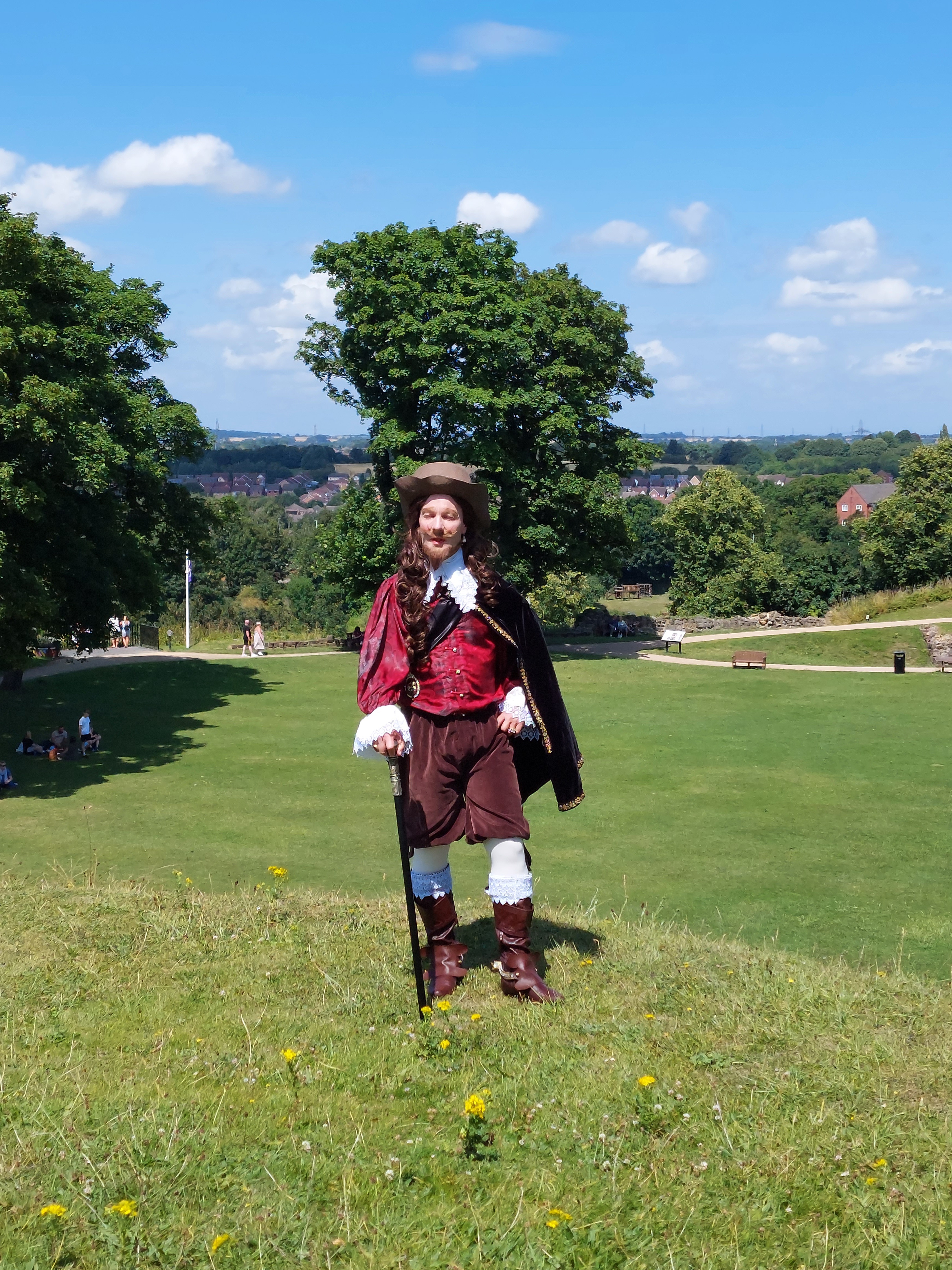 On 9th July 2023, on the day of Pontefract’s Liquorice Festival, Daniel Williams assumed the role of King Charles I on his visit to the castle. Daniel, an avid ‘follower’ from childhood of Britain’s famously executed Civil Wars’ monarch, has appeared as Charles at a range of events over the past six years, such as the Gloucester History Festival, at Dunfermline, Scotland, the Cotswolds and many others. As Daniel remarked: the last time Charles I visited Pontefract was his staying at the castle on May 23 1633, during his 'Great Progress' of the nation to Scotland for his coronation in Edinburgh at the Palace of Holyroodhouse on 18th June. On 9th July 2023, on the day of Pontefract’s Liquorice Festival, Daniel Williams assumed the role of King Charles I on his visit to the castle. Daniel, an avid ‘follower’ from childhood of Britain’s famously executed Civil Wars’ monarch, has appeared as Charles at a range of events over the past six years, such as the Gloucester History Festival, at Dunfermline, Scotland, the Cotswolds and many others. As Daniel remarked: the last time Charles I visited Pontefract was his staying at the castle on May 23 1633, during his 'Great Progress' of the nation to Scotland for his coronation in Edinburgh at the Palace of Holyroodhouse on 18th June. |
| 10/7/1237 | On 10th July 1237, John de Lacy, lord of Pontefract, was made Constable of Chester and Beeston Castles. |
| 10/7/1423 | On 10th July 1423, safe conduct was granted to William de Fowlis, secretary of Archibald, Earl of Douglas, to travel to Pontefract to treat for a final peace between Scotland and England. |
| 10/7/1645 | On 10th July 1645, the besieged Royalist garrison received an account of the engagement between Sir Thomas Fairfax and General Goring, when it was said that Goring routed Sir Thomas and that Taunton was taken. A drum came from Newark to know whether the castle had surrendered as the Parliamentary forces had spread the rumour that Pontefract Castle had yielded to them. The drum had been kept a prisoner overnight in the house of a Mrs Washington whose husband was in the castle. The drum and Mrs Washington went to the castle where the message was passed on and Mrs Washington, while pretending to shake hands with an acquaintance, gave him two letters. These letters named the day and hour when Sir Marmaduke Langdale intended to come to the garrison's relief and confirmed the account of Goring's victory over Sir Thomas Fairfax. Thus the garrison was encouraged and still continued to annoy the Parliamentary forces as much as possible. |
| 11/7/1372 | On 11th July 1372, Edward III’s fourth surviving son, Edmund of Langley, married his elder brother John of Gaunt’s (lord of Pontefract) wife’s younger sister, Isabella of Castile. She was the daughter of the late King Peter of Castile meaning that Edmund and his heirs were now ‘reserves’ in line for the Castilian throne behind Gaunt. |
| 11/7/1645 | On 11th July 1645, Nathan Drake, Royalist diarist, recorded: ‘ ….This evnings there was 2 boanfires made upon Sandoll Castle, wch we answered wth one from the Round Tower. This day the 2 men wch we sent out 10 daies since to Newarke Came againe to towne, & though they Could not get into the Castle to us yet they Showed forth such signes as we knew we had good newes towards us. This night 2 of those men we sent out 2 nightes before to Sandoll cami in againe.’ |
| 11/7/1656 | On 11th July 1656, Mary Fisher of Pontefract, and another preacher, Ann Austin, were the first Quakers to visit the English North American colonies arriving in Boston’s Massachusetts Bay Colony on board the Swallow. Having already converted the island of Barbados’s Lieutenant Governor to Quakerism, their reception by the New England Puritans was decidedly more hostile and they were imprisoned for five weeks, undressed in public and examined for signs of witchcraft with their books and pamphlets burned, then deported back to Barbados. A 1658 mission ‘testifying to the Universal Light’ (her words) to the Ottoman Empire to explain Quakerism to Sultan Mehmed IV was received attentively and ‘he was very noble unto me and so were all that were about him’. |
| 12/7/1203 | On the 12th July 1203, Isabel de Warenne, the widow of Hamelin de Plantagenet and the 4th Earl of Surrey and owner of Sandal castle, died and was buried next to Hamelin in the Chapter House at Lewes Priory. |
| 12/7/1288 | On 12th July 1288, Alice de Lacy, daughter of Sir Henry de Lacy, lord of Pontefract, was granted letters patent of the castle, town, manor and Honour of Halton in the county of Chester, for and during her life with reversion after her death to the king and his heirs. |
| 12/7/1383 | On 12th July 1383, after the Scots had attacked Wark Castle on the border, John of Gaunt, lord of Pontefract, held talks with their king’s heir, Earl John of Carrick, at Muirhouselaw with a truce agreed on 17th July to last until 2nd February the following year. |
| 12/7/1444 | On 12th July 1444, a Charter of Confirmation was made at Pontefract by, John, 7th Earl of Sutherland: ‘Charter of Confirmation by John, seventh Earl of Sutherland, to Alexander Sutherland, lord of Torboll, of the lands of Torboll. Confirmation, by John, seventh Earl of Sutherland, narrating that he had seen and caused to be read before him at Pontefract in England, a resignation made by Nicholas of Sutherland, lord of the castle of Duffus, at St. Andrew's chapel, of the lands and tenements of Thurboll with the pertinents, namely, lands to the worth of £40 lying within the earldom of Sutherland and shire of Inverness, into the hands of Robert, Earl of Sutherland, as his overlord, whereupon the Earl granted them to Henry of Sutherland, son of Nicholas, in fee and heritage, to him and his heirs male from the Earl and his heirs, for payment of ward and relief and for rendering three suits at the court of the said Earl in Sutherland.’ |
| 12/7/1537 | On 12th July 1537, Robert Aske, one of the leaders of the Pilgrimage of Grace, who had besieged Pontefract Castle the previous year, was drawn through the main streets of York on a hurdle prior to execution on a special scaffold erected outside Clifford’s Tower. Rather than experience a traditional hanging, Aske was reputedly hanged alive in chains being slowly suffocated to death, taking several days to die. |
| 12/7/1645 | On 12th July 1645, Royalist troops received a letter that Sir Marmaduke Langdale had set off with his own forces and 4,000 Irish to raise the siege of Pontefract Castle. The letter was designed to raise spirits and produced the effect intended and the castle agreed to suffer any privations rather than submit to disgraceful terms. If relief did not come, they would consume all food in the castle, set it on fire and either cut their way out through the enemy or nobly fall. After this, two flags of defiance were flown, one from the King's Tower and one from the Round Tower. |