This Coming Week In History
This week in history
| Date | Event |
|---|---|
| 1/10/1310 | In October 1310, Edward II decided the time was right to deal with the deteriorating military situation in Scotland. In February 1310, the Lords Ordainers had been established: a diverse group of twenty-one elected by an assembly of magnates. They consisted of eight earls, seven bishops and six barons, their natural leader being Henry de Lacy, Earl of Lincoln and Baron of Pontefract. Probably deciding a Scottish battlefield was a safer place for Gaveston than a meeting of English magnates, Edward II headed north. However, hardly any nobles were prepared to support him; the only exceptions being the Earl of Gloucester and John de Warenne, the seventh and last Earl of Surrey and owner of Sandal castle. |
| 1/10/1317 | In early October 1317, as Edward II passed through Pontefract on his way from York to London, the Earl of Lancaster’s forces jeered at him from the battlements of the castle. This was a ‘treasonous’ charge later levelled at Lancaster at his trial at the castle five years afterwards. |
| 1/10/1330 | On 1st October 1330, Edward III was at Pontefract and ordered that: ‘To the justices of the Bench. Order not to put John de Insula Vectra, knight, in default for not appearing on Monday the morrow of three weeks from Easter last in a suit before the justices between him and Walter, abbot of Hyde near Winchester, and Richard le Cornmangere concerning the unjust taking and detinue of John’s cattle, as he was in the king’s service by his order on that day.’ |
| 1/10/1359 | On 1st October 1359, Henry of Grosmont, 1st Duke of Lancaster, lord of Pontefract, arrived at Calais with an advance party to meet German mercenaries and raid the Somme. Lancaster was spearheading Edward III’s invasion of France intended to have himself crowned at Rheims after a devastating ‘chevauchee’ of the local regions thereby putting pressure on the Dauphin. |
| 1/10/1376 | In October 1376, very soon after his son’s (Edward of Woodstock) funeral on the 29th September, Edward III made an entail declaring Woodstock’s son, Richard of Bordeaux (the future Richard II) his heir, excluding his granddaughter Philippa of Clarence, only child of his late second/third son, Lionel of Antwerp, from the succession. In doing this, Edward also declared that his third/fourth son, John of Gaunt, lord of Pontefract, and his male heirs came after Richard in succession, then Edmund of Langley and his male heirs, then Thomas of Woodstock and his male heirs. This declaration effectively excluded Gaunt from the throne, contradicting King John’s means of succession nearly two hundred years before when he had taken precedence over his nephew, Arthur of Brittany. It also heralded a child king (as Edward III was by then old and feeble) with all the likely problems of a minor’s rule; and can, by some, be seen as the beginnings of dynastic turbulence leading to the Wars of the Roses. |
| 1/10/1397 | On 1st October 1397, on the orders of Richard II, John of Gaunt, lord of Pontefract, led a party to exhume the body of the executed Earl of Arundel and bury it in an unknown location to prevent his grave being used as a site of political martyrdom. Gaunt was awarded some of Arundel’s Norfolk lands in recompense. |
| 1/10/1399 | On 1st October 1399, Sir Richard of Bordeaux (formerly Richard II) was informed, in the Tower of London, of the Parliamentary approval of his renunciation of the crown. Sir Richard William Thirning, chief justice, speaking ‘in the name of the estates and the people’, declared the end of their homage and allegiance. Within five months, he would be dead, having reputedly starved (unlike Shakespeare's more gory version) in his prison at Pontefract Castle. the Tower of London, of the Parliamentary approval of his renunciation of the crown. Sir Richard William Thirning, chief justice, speaking ‘in the name of the estates and the people’, declared the end of their homage and allegiance. Within five months, he would be dead, having reputedly starved (unlike Shakespeare's more gory version) in his prison at Pontefract Castle. |
| 1/10/1419 | On 1st October 1419, Henry V is with his army at Gisors in Normandy where he composes a letter to his chancellor, Thomas Langley, Bishop of Durham, instructing him to ensure that Pontefract Castle’s security is watertight. The castle was not only the place where Richard II ended his life but also a venue for other high-value prisoners, most notably at this time, Charles, Duke of Orléans, (captured at Agincourt) nephew of France’s Charles VI. ‘See and ordain that good heed be taken unto the secure keeping of our French prisoners..for their escaping….might never have been so harmful nor prejudicial to us as it might be now….which God forbid’ Langley must ensure Charles’ gaoler is not so ‘blinded by the said duke that he must be reckless of his keeping’. |
| 1/10/1645 |  On 1st October (some sources say 3rd) 1645, Colonel Bonivant surrendered the Royalist garrison at Sandal at 10 am. The garrison consisted of ten officers and ninety men. They surrendered 100 muskets, 50 pikes, 20 halberds, 150 swords and 2 barrels of gunpowder. No artillery was mentioned in the inventory. The Royalist defenders marched to Welbeck House in north Nottinghamshire. On 1st October (some sources say 3rd) 1645, Colonel Bonivant surrendered the Royalist garrison at Sandal at 10 am. The garrison consisted of ten officers and ninety men. They surrendered 100 muskets, 50 pikes, 20 halberds, 150 swords and 2 barrels of gunpowder. No artillery was mentioned in the inventory. The Royalist defenders marched to Welbeck House in north Nottinghamshire. |
| 1/10/1674 | On 1st October 1674, Lieutenant-General George FitzRoy, was created Earl of Northumberland, Baron of Pontefract and Viscount Falmouth. He was the third and youngest illegitimate son of Charles II and Barbara Villiers (and Charles’ fifth of eight illegitimate sons). |
| 1/10/2019 | On 1st November 2019, DigVentures started a five-weeks' archaeological dig to uncover the gatehouse that had protected Pontefract Castle's main entrance in the 1300s. |
| 2/10/1295 | The auditing of the de Lacy (Henry, lord of Pontefract) accounts for 1295—6 was carried out between October and December, beginning at Pontefract on 2nd October and ending at Denbigh on 9th December. Between these dates, the auditors travelled to Bolingbroke, Wrangle and Swaton (Lincs.) in October, to Kingston Lacy (Dorset), Aldbourne (Wilts.), and Halton (Cheshire) in November, and then to Sedgebrook (Lincs.), and Kneesall (Notts.) in December. |
| 2/10/1348 | On 2nd October 1348, Alice de Lacy, wife of Thomas Earl of Lancaster, died, aged 66, at Barlings Abbey in Lincolnshire. During her life, Alice was married three times, widowed twice, abducted, imprisoned and had her inheritance taken from her. Yet throughout her life she remained generous and respected by her subordinates and those who were dependent upon her. |
| 2/10/1452 |  Richard, Duke of York's (lord of Sandal Castle) son, Richard, Duke of Gloucester, was born at Fotheringhay on Monday, 2nd Oct 1452. He would later become King Richard III. Richard, Duke of York's (lord of Sandal Castle) son, Richard, Duke of Gloucester, was born at Fotheringhay on Monday, 2nd Oct 1452. He would later become King Richard III. |
| 2/10/1484 | On 2nd October 1484, Richard III appointed John Downey as Treasurer of the Household at Sandal Castle at 2,000 marks per annum (over £1.4m today) to cover the expenses of running such. John had held the same role at Richard’s castle at Middleham. |
| 3/10/1263 | In early October 1263, John de Warenne, 6th Earl of Surrey and lord of Sandal, along with Henry of Almain, the Earl of Norfolk and his brother, Hugh Bigod, and many Marcher lords, deserted Simon de Montfort and rejoined the court party of Henry III at Windsor Castle. After the king’s proclamation that summer that he would observe the Provisions of Oxford, de Montfort’s unworkable demand to expel all foreigners from England and refusal to allow any of his supporters to be brought to justice for that summer’s violence caused many of his supporters to drift away. |
| 3/10/1283 | On 3rd October 1283, the ‘rebel’ Welsh lord Dafydd ap Gruffud, Prince of Wales, was hanged, drawn and quartered in Shrewsbury on the orders of Edward I: the first prominent person recorded to have been executed in this manner. Dafydd and his younger son, Owain ap Dafydd, had been captured on 22nd June and his other son, Llywelyn ap Dafydd, on the 28th of that month. On 15th July 1283, Sir Henry de Lacy, lord of Pontefract, had been issued with letters patent to have custody of, and deliver, as hostage, Llywelyn to Richard de Boys. Both of Dafydd’s sons were imprisoned at Bristol Castle; Llywelyn dying in mysterious circumstances in 1287 or 1288 whilst his brother lived at least until August 1325. |
| 3/10/1830 | On 3rd October 1830, a cow belonging to Mr Sudbury, of Pontefract, gave birth to a full-grown calf with two heads, two breasts, two necks, four fore-legs, two hearts, two livers and lights, two back bones separated as far as the sixth rib then joining into one back, two tails and only two hind legs, with each body possessing perfect and distinct intestines. |
| 4/10/1648 | Parliamentarian Robert Brier was a prisoner at Pontefract Castle in early October 1648. Brier was released on parole in November, but refused to surrender himself again. |
| 4/10/1683 | On 4th October 1683, George Shillitoe was buried in Pontefract. He had been besieged in Royalist Pontefract Castle in 1644-45, Alderman of the town in 1662, Mayor in 1662 and 1680 and by deed dated 12th September 1654 had acquired forfeited Royalist estates in Purston, Featherstone, Pontefract and Ackworth. His will, dated 31st July 1683, left to his son, Richard, tenants’ right in the Lease of the Lands and Tenements belonging to University College, Oxford. |
| 5/10/1190 | On 5th October 1190 (some sources have the 11th), John fitz Richard, eldest son and heir of Richard fitz Eustace and Albreda de Lisours and first cousin once removed of Robert de Lacy, was killed at Tyre in the Holy Land on the Third Crusade led by Richard I. His son, Roger fitz John/de Lacy inherited the Pontefract fee. |
| 5/10/1318 | The wardrobe account for 1318-19, gives the names, seven hundred and fifty in all, of those to whom Thomas, Earl of Lancaster, lord of Pontefract, sent letters during the year. Especially large numbers of letters were issued between 5th and 8th October 1318, presumably to summon his followers to attend him at the parliament which had been called for 20th October at York. The on-going ill-feelings between the king and Lancaster made both parties extremely wary of the other. On this occasion, Lancaster wrote to twenty-five knights who were members of his retinue. Counting the different knights who received various letters, the maximum number of knights that can be shown to have served him during the year was forty two. |
| 5/10/1536 | On 5th October 1536, Lord Thomas Darcy sent his son, Sir Arthur to Henry VIII warning of risings in Northumberland, Dent, Sedbergh and Wensleydale and that ‘greater rebellions were to be feared’ in the impending (as it was to be called) Pilgrimage of Grace. He left his family seat at Templehurst (near Selby) for Pontefract Castle finding, on his arrival, that fewer than one third of its 300-strong garrison could be trusted as many favoured the rebels. |
| 5/10/1671 | On 5th October 1671, an order of sessions fixed the fees payable to the gaoler by the prisoners (debtors) kept at Pontefract Castle’s Main Guard (outside the present main entrance) according to their status: Knight, Esquire, Yeoman or Artificer. The Main Guard was, a century later from 1763, used as a place of detention for French prisoners of war. |
| 6/10/1319 | After Edward II’s retreat from the siege of Berwick, York was reached on 5th October 1319 and on the following day the king wrote to Thomas, Earl of Lancaster, by this time probably at Pontefract again. The crushing English defeat at the Battle of Myton the previous month had shown too clearly the need for an urgent overhaul of the country’s defence system, and this was the main subject discussed at a council meeting on 13th October. |
| 6/10/1536 | On 6th October 1536, Lord Thomas Darcy wrote to Henry VIII for guns and powder in order to defend the garrison at Pontefract. Darcy’s efforts to provision the castle were being hampered by lukewarm local support and the king himself had little money or arms to spare being preoccupied with Robert Aske’s Lincolnshire rebellion against the establishment of the Church of England, dissolution of the monasteries and other Crown policies closely identified with Thomas Cromwell. . |
| 7/10/1282 | On 7th October 1282, Sir Henry de Lacy, lord of Pontefract, was with Edward I at Rhuddlan witnessing a grant of land to John de Warenne, Earl of Surrey and owner of Sandal Castle. |
| 7/10/1322 | On 7th October 1322, The Register of William Melton, Archbishop of York, noted the prohibition of the worship of the executed (at Pontefract in March of that year) Thomas, Earl of Lancaster: ‘…… none shall come publicquely through veneration or devotion to the Tombe of Thomas, late Earl of Lancaster at Pontefract”. |
| 7/10/1323 | On 7th October 1323, William Melton, Archbishop of York, mandated the Archdeacon of York to prevent any veneration of Thomas of Lancaster (executed at Pontefract the previous year) as a saint, pointing out that this had not been sanctioned by the Apostolic See. |
| 7/10/1745 | On 7th October 1745, Lady Sophia Fermor, the second daughter of Thomas, 1st Earl of Pontefract died of fever aged twenty-four a few weeks after the birth of her daughter. Sophia was reputedly the author of ‘Woman Not Inferior to Man’, a radical text proclaiming the rights of women including quotes: 'I think it evidently appears, that there is no science, office, or dignity, which Women have not an equal right to share in with the Men: Since there can be no superiority, but that of brutal strength, shewn in the latter, to entitle them to engross all power and prerogative to themselves: nor any incapacity proved in the former, to disqualify them of their right, but what is owing to the unjust oppression of the Men, and might be easily removed…………. We must be at least as well qualified as [Men] to teach the sciences; and if we are not seen in university chairs, it cannot be attributed to our want of capacity to fill them, but to that violence with which the Men support their unjust intrusion into our places………. And as our sex, when it applies to learning, may be said at least to keep pace with the Men, so are they more to be esteem'd for their learning than the latter: Since they are under a necessity of surmounting the softness they were educated in (...) to which cruel custom seem'd to condemn them; to overcome the external impediments in their way to study; and to conquer the disadvantageous notions, which the vulgar of both sexes entertain of learning in Women. (...) it is self-evident, that many of our sex have far outstript the Men. Why then are we not as fit to learn and teach the sciences, at least to our own sex, as they fancy themselves to be?' |
Last week in history
| Date | Event |
|---|---|
| 21/9/1327 | On 21st September 1327, Edward II was ‘murdered’ at Berkeley Castle on the orders of his wife Isabella and her lover Roger Mortimer. With the king's death, Isabella’s new estates were worth 20000 marks (£18.3 million in today's money), an income greater than even Thomas of Lancaster at the height of his powers. Indeed one of the estates Isabella now controlled was Pontefract castle. |
| 21/9/1368 | On 21st September 1368, Thomas Swynford, son of Sir Hugh Swynford and Katherine (later Duchess of Lancaster) was born. Some have questioned whether he was an illegitimate child of John of Gaunt, receiving 100 marks (over £77,000 in today's money) in his will. In 1390, Thomas served with Henry of Derby (later Henry IV) in Calais and later Prussia. In addition to being Constable of Pontefract Castle, in 1402 he was Sheriff of Lincoln, Captain of Calais by 1404 and was later involved in negotiating a treaty with France and Flanders. |
| 21/9/1371 | 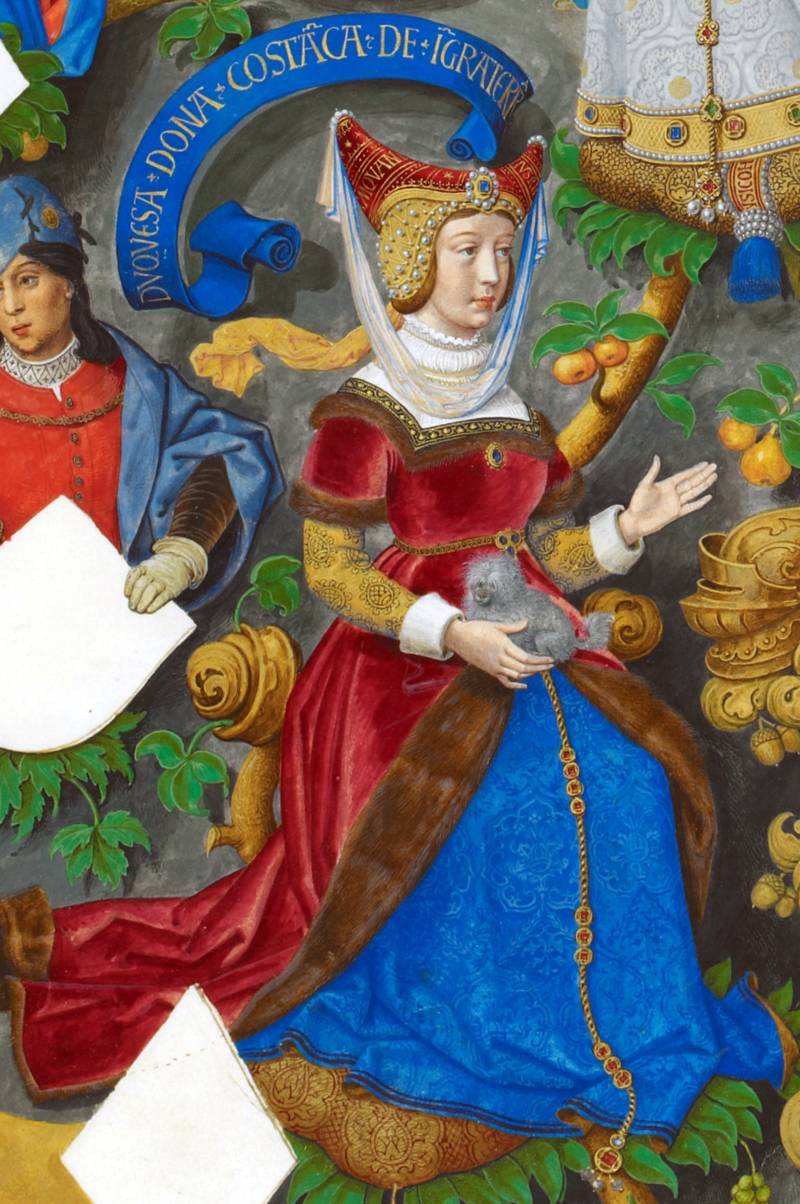 On 21st September 1371, John of Gaunt, lord of Pontefract, married Constance of Castile. It was his second marriage, whereas his first marriage had been for love, this marriage was for ambition. By this marriage, he became King of Castile and Leon, and he was addressed by that title from that point on. After this, the lords of Pontefract grew in strategic, military and political importance in the country. On 21st September 1371, John of Gaunt, lord of Pontefract, married Constance of Castile. It was his second marriage, whereas his first marriage had been for love, this marriage was for ambition. By this marriage, he became King of Castile and Leon, and he was addressed by that title from that point on. After this, the lords of Pontefract grew in strategic, military and political importance in the country. |
| 21/9/1397 | On 21st September 1397, John of Gaunt, lord of Pontefract, in his role as Steward of England, presided over the trial of Richard Fitzalan, 4th Earl of Arundel, regarding his part in an armed, traitorous insurrection against the king by the Lords Appellant ten years earlier. Gaunt condemned Arundel ‘to be drawn, hanged, beheaded and quartered, and the lands descending from your person, both entailed and unentailed, to be forfeited forever by you and your heirs.’ Richard II commuted the sentence to beheading only. The Earl of Warwick, Thomas de Beauchamp, a co-conspirator, was banished to the Isle of Man and Gaunt’s brother, Thomas of Woodstock, the Duke of Gloucester, was posthumously tried and declared a traitor. Sir Thomas Mortimer, another Lords Appellants’ rebel, died in exile in 1399. |
| 21/9/1411 | On 21st September 1411, Richard Duke of York was born at Conisbrough to Richard 3rd Earl of Cambridge and Anne Mortimer. Richard would become one of the most pivotal figures of the first half of the fifteenth century: challenger, Protector and ultimately claimant to the English throne. Richard’s northern base would be at Sandal Castle and Richard would die on the 30th December 1460 at the Battle of Wakefield, in sight of his castle. |
| 21/9/1474 | On 21st September 1474, Richard, Duke of Gloucester (later Richard III), opened a commission of oyer and terminer (judges of assize inquiring into all treasons, felonies and misdemeanours in specified counties) at Pontefract Castle. The commission, lasting until the 25th of the month, was intended to resolve peacefully a bitter dispute between two of the North’s most powerful lords, Sir John Savile and Sir John Pilkington but, unfortunately, clashes continued until Pilkington’s death in 1479. Richard’s unsuccessful intervention in this case was, nevertheless, indicative of his overall ‘calming’ influence during his tenure as ‘Lord of the North’ which improved the prospects of peace and prosperity in the region. |
| 21/9/1478 | Between 21st and 25th September 1478 at Pontefract Castle, Richard, Duke of Gloucester, presided, with Edward IV, over a commission of oyer and terminer (an inquiry into treasons, felonies and misdemeanours committed in specific counties). |
| 21/9/1483 | On 21st September 1483, Richard III and Queen Anne left York having witnessed their son’s investiture as Prince of Wales and Earl of Chester, to travel to Pontefract, staying there until early October. It is likely that news of potential uprisings in the south reached Richard at this time. |
| 22/9/1200 | On 22nd September 1200, Roger de Lacy, lord of Pontefract, was with King John at Lincoln as witness to William the Lion’s, King of Scotland, public submission and act of homage to John. |
| 22/9/1305 | On 22nd September 1305, Edward of Caernarfon (future Edward II) wrote one of several letters to Thomas, Earl of Lancaster and future lord of Pontefract, showing that, at this time, the two were on very close personal terms: ‘Very dear cousin, we hold you well excused that you have not come to us, and your illness grieves us much, and if we can come to you we will do it willingly, to see and to comfort you.’ |
| 22/9/1345 | On 22 September 1345, Henry, 3rd Earl of Lancaster and younger brother of the executed Thomas of Lancaster, lord of Pontefract, died at Leicester Castle. He had been head of the regency council for the new king, Edward III, Captain-General of all royal forces in the Scottish Marches and had been one of the advisers of seven-year-old Prince Lionel, keeper of England, when Edward had gone to Flanders in July. He had been blind for the last 15 years of his life. |
| 22/9/1411 | On 22nd September 1411, Anne Mortimer (mother of Richard Plantagenet, later Duke of York and lord of Sandal Castle) died, the day after she gave birth to her son. At almost four years old, Richard became an orphan on the execution of his father, the Earl of Cambridge, for treason. With two childless uncles - Edmund Mortimer, 5th Earl of March (died 1425), and Edward of Norwich, 2nd Duke of York (killed 1415) - Richard Plantagenet inherited Mortimer’s property and claim to the throne. Richard’s guardianship and wardship were under Sir Robert Waterton, Ralph Neville (Earl of Westmorland who paid 3,000 marks -£2.7 million today- for this wardship) and on the latter’s death, his widow, Joan Beaufort, youngest daughter of John of Gaunt and half-sister of the dead King Henry IV. Richard’s marriage to Ralph Neville’s youngest daughter, Cecily, by 1429 (the exact date is unknown) completed the first phase of the Yorkist dynastic ramifications regarding the later Wars of the Roses. |
| 22/9/1465 | On 22nd September 1465, a nearly thirteen-year- old Richard, brother of Edward IV, Duke of Gloucester and steward of the Duchy of Lancaster north of Trent with official residence at Pontefract Castle, was a principal guest at the enthronement (and later immense feast) of George Neville, the new Archbishop of York, at Cawood Castle, the palace of such archbishops. Seated with Richard were his elder sister Elizabeth, Duchess of Suffolk, the Countesses of Westmorland and Northumberland and two of the Earl of Warwick’s daughters, Isabel and Anne; the latter to be Richard’s wife and queen. |
| 22/9/1483 | On 22nd September 1483, whilst at Pontefract Castle, Richard III, hearing news of southern discontent, removed Robert Morton, a nephew of Bishop John Morton, from his post as Master of the Rolls of Chancery, a key administrative position. On this day, Richard also wrote to Southampton and probably other south coast towns telling the mayor to prevent the wearing of livery badges within the town, concerned about such ports being incited to rebel from foreign shores. |
| 23/9/1199 | On 23rd September 1199, Roger de Lacy, nominal lord of Pontefract, was made castellan of Chinon on King John’s campaign to France to hold onto his Angevin lands. Chinon was of major strategic importance to the king’s Angevin empire, commanding the borders of Anjou and Poitou and overlooking Touraine. Pontefract Castle was subsequently released back to Roger by the king albeit his eldest son, John, was held hostage by the king as surety for his loyalty. |
| 23/9/1217 | On 23rd September 1217, John de Lacy, lord of Pontefract, was ordered to oversee the restoration of Carlisle Castle by Alexander II, king of Scotland, and later on the 6th November accompany Alexander to meet Henry III. |
| 23/9/1371 | On 23rd September 1371, John of Gaunt, lord of Pontefract, having spent a year trying to restore the ruinous state of Aquitaine’s government and with over half of the Black Prince’s army having deserted due to lack of payment, formally resigned the post of Lieutenant of Aquitaine. He returned to England with less than half of his eight hundred men who had come with him. |
| 23/9/1483 | On 23rd September 1483, whilst at Pontefract Castle, Richard III, hearing news of southern discontent, seized all the possessions of Lionel, Bishop of Salisbury, one of Elizabeth Woodville’s brothers. |
| 24/9/1317 | On 24th September 1317, the Earls of Hereford and Pembroke were commissioned to release all those who had been arrested as followers of Thomas, Earl of Lancaster (lord of Pontefract) and to protect him and his men until the coming parliament in late January 1318. Lancaster, having given up the custody of the bridges which he had been holding against the king, then returned in peace to Pontefract while Edward II paid off his army and on 29th September started southwards again. |
| 25/9/1177 | On 25th September 1177, Henry de Lacy, lord of Pontefract, accompanying the Earl of Essex and Count of Flanders, died on crusade to the Holy Land. This was Henry’s second crusading venture having campaigned in 1158 and most probably being exempted from taxation that year on account of this action. |
| 25/9/1478 | On 25th September 1478, Edward IV was at Pontefract Castle where he witnessed the founding of the Nowell Chantry by Roger Nowell of Wakefield, at the altar of the blessed Apostle Peter, in the north aisle of the Parish Church of All Saints, Wakefield. The chantry was sometimes erroneously called the Thurstan or Banaster (after Sir Thurstan Banaster) chantry who was the cousin of Roger Nowell; Banaster being mentioned in the deed of foundation. |
| 26/9/1300 | On 26th September 1300, Sir Henry de Lacy, lord of Pontefract, was Chief Ambassador to Pope Boniface VIII during the Pope’s proclaimed ‘Jubilee Year’, during which he encouraged mass crowds to pilgrimage to Rome and supply much-needed money to the papacy. Henry was later to be Joint Ambassador to Pope Clement V on 15th October 1305. |
| 26/9/1644 | On 26th September 1644, Royalists billeted infantry and cavalry troops in Pontefract. The cost on the town can be deduced from contemporary records to be around £21. 13s. 4d. (£2547 in today's money) for one day and night. This would be a huge expense for the town if troops were there for extended periods. |
| 26/9/1934 |  On 26th September 1934, a World War 1 tank (tank No. 289), on display at Pontefract Castle since 1919, was removed from the castle to Nevison's Leap. The tank was eventually cut up for salvage in World War II. On 26th September 1934, a World War 1 tank (tank No. 289), on display at Pontefract Castle since 1919, was removed from the castle to Nevison's Leap. The tank was eventually cut up for salvage in World War II. |
| 27/9/1304 | On 27th September 1304, John de Warenne, 6th Earl of Surrey, died at Kennington in Kent, soon after returning from Scotland, and was interred at Lewes Priory with the service conducted by the Archbishop of Canterbury. John, the son of William de Warenne and Maud Marshall, had taken ownership of Sandal Castle in 1240 and would marry Alice de Brun de Lusignan in 1247, which would cause resentment amongst other nobles as she was penniless. On his death, his grandson, John de Warenne, would take ownership of Sandal becoming the 7th and last Earl of Surrey. |
| 27/9/1450 | On 27th September 1450, Richard, Duke of York (lord of Sandal Castle), met Henry VI at Westminster Palace after his precipitate return from Ireland without royal leave. York had arrived in London with a retinue of thousands and a riot had occurred at Newgate Prison. Henry was prepared to meet York ‘as our true faithful subject and as our well-beloved cousin’ but would not let him incite a witch-hunt against his advisers whom he accused of ‘inestimable extortions’ and oppressions against the English people. York was invited to join Henry’s proposed council to deal with questions of justice but with no superior authority to any other member. York retired disappointed to East Anglia. |
Next week in history
| Date | Event |
|---|---|
| 5/10/1190 | On 5th October 1190 (some sources have the 11th), John fitz Richard, eldest son and heir of Richard fitz Eustace and Albreda de Lisours and first cousin once removed of Robert de Lacy, was killed at Tyre in the Holy Land on the Third Crusade led by Richard I. His son, Roger fitz John/de Lacy inherited the Pontefract fee. |
| 5/10/1318 | The wardrobe account for 1318-19, gives the names, seven hundred and fifty in all, of those to whom Thomas, Earl of Lancaster, lord of Pontefract, sent letters during the year. Especially large numbers of letters were issued between 5th and 8th October 1318, presumably to summon his followers to attend him at the parliament which had been called for 20th October at York. The on-going ill-feelings between the king and Lancaster made both parties extremely wary of the other. On this occasion, Lancaster wrote to twenty-five knights who were members of his retinue. Counting the different knights who received various letters, the maximum number of knights that can be shown to have served him during the year was forty two. |
| 5/10/1536 | On 5th October 1536, Lord Thomas Darcy sent his son, Sir Arthur to Henry VIII warning of risings in Northumberland, Dent, Sedbergh and Wensleydale and that ‘greater rebellions were to be feared’ in the impending (as it was to be called) Pilgrimage of Grace. He left his family seat at Templehurst (near Selby) for Pontefract Castle finding, on his arrival, that fewer than one third of its 300-strong garrison could be trusted as many favoured the rebels. |
| 5/10/1671 | On 5th October 1671, an order of sessions fixed the fees payable to the gaoler by the prisoners (debtors) kept at Pontefract Castle’s Main Guard (outside the present main entrance) according to their status: Knight, Esquire, Yeoman or Artificer. The Main Guard was, a century later from 1763, used as a place of detention for French prisoners of war. |
| 6/10/1319 | After Edward II’s retreat from the siege of Berwick, York was reached on 5th October 1319 and on the following day the king wrote to Thomas, Earl of Lancaster, by this time probably at Pontefract again. The crushing English defeat at the Battle of Myton the previous month had shown too clearly the need for an urgent overhaul of the country’s defence system, and this was the main subject discussed at a council meeting on 13th October. |
| 6/10/1536 | On 6th October 1536, Lord Thomas Darcy wrote to Henry VIII for guns and powder in order to defend the garrison at Pontefract. Darcy’s efforts to provision the castle were being hampered by lukewarm local support and the king himself had little money or arms to spare being preoccupied with Robert Aske’s Lincolnshire rebellion against the establishment of the Church of England, dissolution of the monasteries and other Crown policies closely identified with Thomas Cromwell. . |
| 7/10/1282 | On 7th October 1282, Sir Henry de Lacy, lord of Pontefract, was with Edward I at Rhuddlan witnessing a grant of land to John de Warenne, Earl of Surrey and owner of Sandal Castle. |
| 7/10/1322 | On 7th October 1322, The Register of William Melton, Archbishop of York, noted the prohibition of the worship of the executed (at Pontefract in March of that year) Thomas, Earl of Lancaster: ‘…… none shall come publicquely through veneration or devotion to the Tombe of Thomas, late Earl of Lancaster at Pontefract”. |
| 7/10/1323 | On 7th October 1323, William Melton, Archbishop of York, mandated the Archdeacon of York to prevent any veneration of Thomas of Lancaster (executed at Pontefract the previous year) as a saint, pointing out that this had not been sanctioned by the Apostolic See. |
| 7/10/1745 | On 7th October 1745, Lady Sophia Fermor, the second daughter of Thomas, 1st Earl of Pontefract died of fever aged twenty-four a few weeks after the birth of her daughter. Sophia was reputedly the author of ‘Woman Not Inferior to Man’, a radical text proclaiming the rights of women including quotes: 'I think it evidently appears, that there is no science, office, or dignity, which Women have not an equal right to share in with the Men: Since there can be no superiority, but that of brutal strength, shewn in the latter, to entitle them to engross all power and prerogative to themselves: nor any incapacity proved in the former, to disqualify them of their right, but what is owing to the unjust oppression of the Men, and might be easily removed…………. We must be at least as well qualified as [Men] to teach the sciences; and if we are not seen in university chairs, it cannot be attributed to our want of capacity to fill them, but to that violence with which the Men support their unjust intrusion into our places………. And as our sex, when it applies to learning, may be said at least to keep pace with the Men, so are they more to be esteem'd for their learning than the latter: Since they are under a necessity of surmounting the softness they were educated in (...) to which cruel custom seem'd to condemn them; to overcome the external impediments in their way to study; and to conquer the disadvantageous notions, which the vulgar of both sexes entertain of learning in Women. (...) it is self-evident, that many of our sex have far outstript the Men. Why then are we not as fit to learn and teach the sciences, at least to our own sex, as they fancy themselves to be?' |
| 8/10/1472 | On 8th (or 9th) October 1472, at Pontefract, Richard, Duke of Gloucester, ordered the arrest of Thomas Farnell for the murder of Katherine Williamson’s husband. |
| 8/10/1536 | On 8th October 1536, Lord Darcy wrote to his son from Pontefract Castle urging him to go rapidly to the king requesting that his son be allowed to help his father (Darcy was nearly seventy-years-old at the time) and, again, warning Henry VIII that Yorkshire was now on the point of rebellion against the king’s religious, political and economic policies. The king’s letters summoning the northern counties to send help to George Talbot, 4th Earl of Shrewsbury, were received at Pontefract this day. |
| 9/10/1483 | Around 9th or 10th October 1483, Richard III, on hearing news of southern discontent, hurriedly left Pontefract to reach Lincoln, via Gainsborough, on his return south. It was here that he heard of Henry Stafford’s, Duke of Buckingham, intention to rebel, possibly because of the delay in his gaining access to the de Bohun inheritance. On the 12th October, Richard wrote to the Chancellor, John Russell, requesting the Great Seal be sent to him immediately. |
| 9/10/1536 | On 9th October 1536, Henry VIII received Lord Darcy’s letters from Pontefract warning of impending religious revolt but replied to Darcy that he was confident there was no danger and instructed him to arrest fugitives and anyone spreading rumours. |
| 9/10/1648 | On 9th October 1648, Parliamentary troops, under Sir Henry Cholmley, (JP for the West Riding of Yorkshire, commissioner for the militia in Yorkshire and colonel of foot in the Parliamentary army) entered Pontefract, having previously occupied the villages of Ackworth, Featherstone and Ferrybridge. |
| 10/10/1326 | On 10th October 1326, Edward II and Hugh Despenser the Younger, had reached Gloucester from the Tower of London attempting to reach the safety of Despenser’s strongholds in south Wales. They were fleeing from Queen Isabella’s and her lover Roger Mortimer’s, invasion from Dordrecht, aided by mercenaries from the Low Countries and Germany, soldiers from the Count of Hainault and financial guarantees by the king of France. Unfortunately, for Edward, news came that Thomas of Lancaster’s (lord of Pontefract) brother, Henry who had not supported his brother’s revolt four years earlier and had been allowed to inherit some of his estates, now had turned to Isabella’s cause. |
| 10/10/1361 | On 10th October 1361, John of Gaunt, lord of Pontefract, attended the marriage of his brother, the Black Prince, to Joan, Countess of Kent, at Windsor; the Pope had given his assent to the union as Edward and Joan were related in the second and third degree. |
| 10/10/1459 | On the 10th October 1459, Richard Duke of York - owner of Sandal Castle - along with the earl's of Salisbury and Warwick, sent a desperate letter to King Henry VI pledging their loyalty. The Yorkist forces had arrived at Ludford Meadow just outside of Ludlow following news from scouts that a royal army, headed by the king himself, and perhaps twice the size of York's forces, was heading to meet them. There was a real sense of panic in the earl's letter stating that they only sought to end 'such inconvenient and irreverent jeopardies as we have been put in diverse times herebofore'. York would state that they only kept 'such fellowship' (referring to the thousands of men they had with them) for their protection and that they would willingly come to the king's presence, if he would grant them safe conduct. However, at the end of the letter, York does seem to take aim directly at Queen Margaret as he recounts to King Henry 'the opportune impatience and violence of such persons as intend of extreme malice to proceed under the shadow of your high might and presence to our destruction'. The letter as a whole had a different resonance to other Yorkist communications and looks to appeal to henry's lifelong love of peace. The change of tone is understandable as they were in a no-win situation. If they fought they would commit treason and risk their lives and inheritance of themselves and their heirs. If they ran, they might save their lives but still lose their lands and inheritance. |
| 10/10/1460 | On 10th October 1460, after the Lancastrians’ defeat at the Battle of Northampton three months earlier, Richard, Duke of York’s (lord of Sandal Castle) armed escort of 800 mounted men stopped at the gates of Westminster Palace and York dismounted with a sword held aloft before him. York approached the empty royal throne in the Painted Chamber and placed his hand upon it awaiting affirmation of his claim to kingship but was met with stunned silence as the assembled lords had no wish to depose an anointed king. |
| 10/10/1536 | On 10th October 1536, the Archbishop of York, Edward Lee, fearing that he was about to be abducted by rebellious ‘commons’ from the Marshland in the West Riding of Yorkshire in the impending rising (as it was to be called) Pilgrimage of Grace, fled to Pontefract Castle with thirty servants to join Dr Magnus from York and Lord Darcy. On this day also, Darcy wrote to the Lord Mayor of York informing him that the commons of the East Riding were likely to invade York and seize the king’s treasure. |
| 11/10/1159 | On 11th October 1159, William of Blois, 4th Earl of Surrey, died. William had taken ownership of Sandal Castle in 1148. William's parents were Stephen, Count of Boulogne, and Matilda Contessa de Boulogne. William had been born circa 1137 but did not want to be king, so his father Stephen acknowledged his cousin Matilda’s son, Henry, as his successor. The two centuries between the death of William of Blois in 1159 and the last Earl of Surrey in 1347 mark the period when the timber castle at Sandal was reconstructed in stone and received its full complement of buildings, which lasted until their destruction in the Civil War. |
| 11/10/1370 | On 11th October 1370, the ailing Black Prince appointed his brother, John of Gaunt, Duke of Lancaster and lord of Pontefract, as his lieutenant in Aquitaine after Gaunt had participated in the siege of Limoges even engaging in hand-to-hand fighting in the undermining tunnels. The Black Prince then returned to England leaving his brother in charge. |
| 11/10/1483 | On 11th October 1483, Richard III, lord of Sandal, was made aware of the Duke of Buckingham’s participation in plots and rebellions that were breaking out. Buckingham had been a trusted and loyal adviser to Richard, being with him at the arrest of Anthony Woodville and instrumental in Richard’s gaining the throne. He had been appointed Chief Justice over Wales and two months before had been commissioned to investigate treasons in London. His role in the so-called murder (or spiriting away) of the Princes in the Tower has been much debated over the centuries with claims of acting at Richard’s command, selfishly seeking the crown himself, or even pursuing Edward V’s ‘rightful’ inheritance, all put forward. A possible motivation for his rebellion is cited as Edward IV’s keeping of thirty-eight manors on Henry Bohun’s death which Buckingham regarded as his inheritance. Buckingham was executed for treason on 2nd November 1483. |
| 11/10/1536 | On 11th October 1536, having received Sir Brian Hastings’ letter from Hatfield advising Lord Darcy, in Pontefract, to send a force immediately to York ‘ to overawe their faction in that city’ (rebels from Howdenshire and Marshland intending to march on York in the Pilgrimage of Grace), Darcy replied: ‘I am putting all the gentlemen within my room in readiness at an hour’s warning, when I shall know the King’s pleasure…If you have any certainty from above let me share it’. |
| 11/10/1619 | A manuscript dated 11th October 1619 declared: ‘ Out of Queen Anne her Joynture. The King (James I) granted &c. and all o’r mann’r of Pontefract in the county of Yorke & other counties wheresoever that hon’r extendeth……..’ A jointure was an estate settled on a wife for the period during which she survived her husband, in lien of a dower. Anne had died in March of that year. |